Showing posts with label Annoyances. Show all posts

Wednesday, May 25, 2016

Movie Fights: Guardians of the Galaxy vs. The Lightning Thief

For some reason, this week has been a Bad Movie Week for me. And when I say that, I mean that my sister and I somehow finished two phenomenally bad movies in the same week. However, as I told my sister while we were watching Percy Jackson: The Lightning Thief: there are two types of bad movies. There are good bad movies, and bad bad movies. And as it just so happens, I watched one of each this week. So here I am to put my classical education to work in the real world and compare those two movies.

I’m going to start with the first installment in the Percy Jackson and the Olympians movie series. Before I get into this, I’d just like to make a note: the Percy Jackson series is very near and dear to my heart, because I started it when I was young, and the writing only improved as I continued reading it into teenager-hood. It’s a good series that blends Greek mythology and modern wit with great characters.

Anyone who’s followed my blog for a length of time knows that few things rile me as much as a movie adaptation desecrating a book that I love. So it is with great loathing and bitter glee that I am about to rip into this laughable excuse for an adaptation.

To start with, I feel that everyone reading this should know that Rick Riordan, the author of the Percy Jackson series, publicly disowned the movies. (Sadly, there’s a second movie. I haven’t seen that one.) As a writer who would love to see some of my ideas on the big screen, that’s a pretty bad sign right there. And oh, let me tell you: the movie was just as bad as I anticipated based on the author’s sentiment alone.

To start, they butchered the characters. Usually I’m not a huge stickler for movie characters looking exactly the way they did in the book, but the one time I actually cared about that, the movies went and changed the character. Anyone who has read the Percy Jackson books knows: Annabeth being a brunette is as much an oxymoron as a warm snowflake. And that’s just the tip of the iceberg.

This movie changed pretty much the entire plot of the book, and had to throw in a bunch of extraneous scenes and details just to support that change. I get that they might not have been able to replicate the book’s plot exactly, but they surely could have done better than they did. They took out the actual villain from the books and used the decoy villain, the guy who didn’t actually do it, as the actual villain. Like I said, they took out a ton of plot from the books, and then stuffed a bunch of nonsensical filler in to try and hide the gaps. That’s not the only problem, though.

Not only is the plot terrible, but the writing in general is just insipid, and the writers utterly butchered nearly every aspect of Greek mythology they could get their hands on. They flat-out ignored every aspect of worldbuilding from the books. They ignored stuff from the original mythology, like the actual conduct of Hades’s and Persephone’s relationship, and the fact that Hades is more of a grumpy introvert than a fire-breathing demon lord. Also, the characters were flat as week-old soda. Percy had none of his sarcasm or snappy repartee from the books. Annabeth was… smart, I guess… but had none of her depth or insight. Grover had some great lines—he was one of the few things I enjoyed about the movie—but he also lacked any and all depth. The movie was over all badly written and a shameless cash-grab only loosely based on the books.

But hey, the special effects were pretty good.

In conclusion, don’t watch The Lightning Thief. Don’t ever watch it. Just read the books and pretend the movie(s) don’t exist. The Lightning Thief is a bad bad movie, and I utterly hated it.

Fortunately, that wasn’t the only movie I watched this week.

The other movie I saw was Marvel’s Guardians of the Galaxy, which I’d been wanting to watch for some time. I’d heard it be called “Marvel trying to do Star Wars”, and maybe that was meant to be a derogatory description, but it just intrigued me more. Plus, it has space pirates. Space pirates are one of my favorite fiction things, and you wouldn’t believe how hard it can be to find things that are about them, so that was also a plus.

I don’t know how close Guardians of the Galaxy is to the original source material. I do know that by most rubrics, it’s a bad movie. I mean, it’s corny. It’s nonsensical. It’s silly. It’s just a little bit surreal. (Which is fitting, I guess, because from what I’ve read the original comics were one heck of a drug trip. You think I’m joking, but I’m not. Look it up.)

The point is, Guardians isn’t a good movie, or even a really well-written one. But it’s fun. It’s big and it’s loud and it’s colorful and it’s funny and it doesn’t take itself seriously. The protagonist is about as generic as they come, yet he’s relatable enough that I enjoyed watching him. The point is, Guardians of the Galaxy is by all measurements a bad movie, but it’s a good bad movie. It owns the silliness, the absurdity of the premise, and it just has fun with it. Yeah, it’s a bad movie, but I like it. I can like bad stuff.

(There you go, Dad. It’s in writing. Happy now?)

There’s not a lot of a difference between The Lightning Thief and Guardians of the Galaxy. By all logic, I should despise the both of them. But The Lightning Thief took one of my favorite book series and tossed it in the mud, so yeah, I’m never touching that movie again, not even with a ten-foot pole. Guardians of the Galaxy took a really weird, nonsensical premise and made it into a fun, silly movie. Sure, it’s not a good movie. I wouldn’t say it’s even as good as Ant-Man. But—much like its protagonist—it’s able to muster enough charm, jokes, and good looks to bluff its way through my common sense and critical analysis. So there’s that. I wouldn’t recommend Guardians of the Galaxy to anybody I know. I will make fun of everything in that movie because it’s the corniest film I’ve seen in a long time.

But I am definitely going to watch it again.

Friday, May 13, 2016

Movie Fights: Ant-Man vs. Pacific Rim

[My review of Pacific Rim] [My review of Ant-Man]

Good morning, everyone! Or, well, good whatever-time-of-day-it-is-where-you-are. Today I'm debuting the first in what will hopefully be an extended category of blog posts, sorta similar to my History Recaps. Movie Fights is a series where I put my classical education to work in the real world and write out a comparison of two movies. Today I'll be talking about a pair of action movies. One features a guy who uses a super-suit to shrink down to an inch tall, and the other is about giant robots slugging it out with giant alien monsters.

As you can see, I'm taking my classical education very seriously.

On the surface, Ant-Man and Pacific Rim don't seem that similar. One is a superhero movie, and the other is more of a general sci-fi action movie. Of course, they're both popcorn summer flicks that you wouldn't think to put a lot of thought into the first time you saw them. To be fair, I have only seen Ant-Man once, but if you've read my review you know I put a lot of thought into it. I've seen Pacific Rim like... four times? So I've had time to analyze it.

So today I'm going to compare the two. Specifically, I'm planning to look at how these two films handled their female characters and characters of color.

Let's start with Ant-Man.

Ant-Man tells the tale of Scott Lang (played by Paul Rudd), a down-on-his-luck thief with a cause who, now that he’s out of jail, is having trouble finding employment. Luckily he’s able to crash with some friends, but he doesn’t quite have the money to pay child support, which means he’s mostly cut off from his young daughter.

That’s the initial setup of the movie. It’s Scott Lang’s story, first and foremost. He’s the main character. He’s a good main character, and Paul Rudd plays the part very well, but he’s nothing new. Nothing groundbreaking. Hollywood loves their white male protagonists, and Marvel especially loves their white male protagonists. Playing opposite Rudd is Evangeline Lilly as Hope Pym, the high-powered corporate executive estranged-from-her-father daughter of Hank Pym.

I like what Evangeline Lilly did with this role. Like most of the actors in this film, she exceeded my expectations and breathed life into a character that wasn’t all that original. My problem is with the way this character was written, because while Hope Pym has a lot of cool character traits, she’s not really a complete character. In the end, she only really exists to prop up the stories of Scott and Hank. Scott and Hank both have their own story arcs; Scott’s is most prominent, seeing as he’s the main character, but Hank has a progression too, and weirdly enough, both Scott’s and Hank’s arcs are very closely tied to Hope’s character. Yet Hope is the only main character, aside from the villain, who doesn’t have her own story arc. Yes, she does reconcile with her father towards the end of the movie, but overall it feels like that’s more for Hank’s benefit than for Hope’s character growth.

I’d like to contrast this with the way Pacific Rim treated its protagonists. At first glance, the main character of Pacific Rim is Raleigh Becket, played by Charlie Hunnam. For the most part, Raleigh seems like your average white male action movie protagonist. He’s a somewhat world-weary veteran Jaeger pilot, who, due to the traumatic loss of his brother in a battle, is not eager to get back to piloting. But he has to, in order to save the world, so he comes back to the world of Jaeger piloting. That’s where he meets Mako Mori, a hopeful pilot.

On the surface, Mako Mori seems to have a similar narrative purpose to Hope Pym. She’s a very integral part of Raleigh’s story, and for about the first half of the movie you assume that that’s it, that it’s Raleigh’s story, not Mako’s.

But as the story progresses, we learn more and more about Mako and her adoptive father, who happens to be a former Jaeger pilot and Raleigh’s commanding officer. We learn Mako’s backstory, we learn what drives her and why she’s so eager to become a real pilot, and by the end of the movie, it’s Mako Mori who has achieved her goals and become a full-fledged character in her own right. It’s Mako Mori who has a concrete story arc and really blossoms by the end of it.
(Raleigh appears to have his own arc—overcoming his hang-ups and trauma about getting back in a Jaeger—but that doesn’t really develop. Actually, once he meets Mako and forms a relationship with her, he seems to settle into his old career with a new ferocity. It’s an interesting dynamic.)

Ant-Man seems to be attempting to tell a father-daughter story with Hank and Hope, but because Pacific Rim allows to Mako Mori to be her own character, and really develops the bad and the good of her relationship with her father, it tells a much better story. That’s the crux of the matter, I think: Pacific Rim allows its heroine to be her own person, her own character, with a backstory and motivations outside of her relationship with Raleigh Becket. Oh, Raleigh and Mako are close, and I love how their relationship develops, but Mako is never forced to sacrifice any part of her character to advance Raleigh’s story. She’s her own person, and she’s treated as such.

Ant-Man… well, as I said, the actors did a lot with what they were given, but the writing isn’t anything to crow about. And Hope Pym? She’s written as a side character meant to be a part of Scott’s story. She’s not given her own arc or her own impetus. On one level, that’s fine. Every story needs supporting characters. Not every character in a story can have their own arc. On another level, though, the treatment of Hope Pym is disappointing, because it’s almost always a female character that receives this type of sidelining in action movies. (The Lego Movie did this too. I love it to pieces, but The Lego Movie did this exact thing with Wyldstyle.)

Women are less likely to be the hero in a contemporarily written story than men are. Women of color are a lot less likely to be the hero, or even be included in the story in the first place. In my opinion, this is (one of the reasons) why Pacific Rim is better-written and more well-rounded movie than Ant-Man is. Pacific Rim gives us Mako Mori, a Japanese woman who is allowed to be the hero of her own story, a Japanese woman who is allowed to be a fully fleshed-out character just like her co-lead. I liked Ant-Man, but it didn’t do this. It stuck to the old formula of using a female character to support and prop up a male hero, just the way many Marvel films so far have. For this reason, I firmly believe that of these two movies, Pacific Rim is the better story.

(Postscript: Ask me about my other, more minor, compare/contrasts of these two movies. I was going to talk about other stuff, but this issue is near and dear to my heart, so it took the forefront. Oh well.)

Wednesday, March 23, 2016

Ant-Man

*Warning: Spoilers are contained in the following post.*

Confession time: I did not think I was going to enjoy Ant-Man.

When I first found out that Marvel was doing an Ant-Man movie, I was pretty excited. Thanks to Avengers: Earth's Mightiest Heroes, I knew who Ant-Man was and I was happy to see him getting a movie.

I got a little less excited when I learned that the movie would actually primarily be about Scott Lang, the second Ant-Man, rather than Hank Pym, the first. But hey, Hank was still in the movie, so I could live with it.

Then I found out that Marvel was not only making it all about Scott, but entirely removing the character of Janet Van Dyne, aka the Wasp. This was the final straw.

To those who don't know why this is a big deal, Janet Van Dyne was a founding member of the Avengers. In fact, Janet Van Dyne named the Avengers. (In more than one continuity!) Janet Van Dyne is the whole reason Hank Pym became a superhero in the first place. And aside from all that, Janet Van Dyne is a really fun character; she's a superhero, and a dang good one, but she's also fun, and humorous, and she's a fashion designer in her free time. (She's also Chinese-American in the Ultimates continuity, which means that Marvel had a wonderful opportunity to include a woman of color in their movie series, and they waved at it as it passed by.)

So yes, I was not happy about Marvel's decision, and as the Ant-Man movie looked pretty boring and generic anyway, I resolved not to watch it.

However, let me tell you from experience: when you are sitting on a plane at four o'clock a.m., having gotten two hours of fitful sleep before giving up on it entirely, none of your carefully thought out reasons for anything will make sense to you. This is how I got roped into finally watching Ant-Man. And...

I actually enjoyed it a lot more than I thought I would.

Let's start with that.

***

So, as it turns out, Ant-Man is actually pretty well-written. It's not as good as Iron Man, which is sort of my benchmark for good writing in the MCU, but it's definitely a lot better than Age of Ultron, which is my benchmark for bad writing in the MCU, because seriously, it was terrible. Ant-Man... well, it had its flaws, but overall it was pretty good. The pacing worked, it had a decent character arc for Scott, and the characters, and their relationships, were all pretty well built up. (With a few notable exceptions, which I'll talk about later.) 

Speaking of the characters, they were... good enough, I suppose. I will always be vaguely bitter about needlessly white movie casts, but as far as acting and characterization went, they were good. That's the interesting thing, I guess: none of the characters in this movie were particularly original or groundbreaking, but they were able avoid being cliché through a combination of good writing and good acting. I thought Evangeline Lilly as Hope Pym and Michael Peña as Luis in particular did a lot with the roles they were given. 

In fact, now that I bring it up, I think the same is true of the plot. Nothing about this movie's plot was particularly original; I think it's safe to say I've seen pretty much every element of this movie somewhere else. But the movie overall manages to avoid seeming generic, which is something I honestly didn't think it would be able to do. 

So overall? I liked how this movie was done. It exceeded my expectations, and I can honestly say I enjoyed it. 

However. 

That having been said, while I liked this movie, there was also a lot I didn't like. And if you think I'm not going to nitpick the heck out of this movie, just because it exceeded my expectations, well. You've got another thing coming, buddy. 

So here we go.

***

To start with, I am still very put out about how Marvel decided to treat Janet Van Dyne in this movie. 

Rather than be included in the movie at all, Janet is killed off to further the story of Hank Pym and his daughter Hope. Her full name isn't even stated anywhere in the movie, and she only appears in one (short) scene, where we don't even see her face. This was annoying enough for me, but it didn't end there. You see, in the movie, Hope Pym--Hank and Janet's daugher--is established and blatantly stated to be, hands down, the most qualified person to steal the volatile technology in question and save the world. However, her father (Hank) is unwilling to put her in danger, so he pulls a random thief guy (Scott) off the street and decides to have her train him to do the heist, so if someone does get hurt, hey, it'll just be that random guy we met a couple days ago. 

(I'll talk more about that a little later.)

This plot decision really, really irks me, because on the surface, yeah! It's a good setup! It works, and the writing supports it! And it leads to an interesting dynamic between the characters! But on a meta-narrative level, it doesn't work, because here we have the only female character in the movie, who is also the most qualified to be the hero. You know what that means? It means that Hope Pym should have been the title character of this movie. It means that the only reason she isn't is because Marvel wanted to make another movie about a mediocre white guy who gets superpowers. It means that this movie has double the sidelining of female characters, and that makes me angry. The movie even acknowledges this, because the mid-credits scene is of Hank finally accepting that his daughter is ready to be a hero and admitting that he's got a prototype Wasp suit ready to be finished! There was literally no reason Marvel couldn't have named this movie The Wasp!

(And as a side note on female characters--and this is more of a nitpick, but still a very annoying one--all of the ants in this movie are female and should have been referred to as such. Sorry, I don't make the rules. They're all girls. Especially Antony. You know why Antony has wings? Because she's a queen. Queens are literally the most female ants ever, and the only ones that have wings. Antony should've been named Antonia. No, I will not get over this.)

My other big problem with this movie is the villain, Darren Cross, aka Yellowjacket. Without getting into how they totally changed around the Yellowjacket suit origin, let me just say I was unsatisfied with how Darren Cross was presented. He's clearly written as having some undefined mental illness, but this is only used to make him seem ~stranger~ and ~scarier~ than the heroes and that irks me, because the MCU has yet to really do anything as far as disabled superheroes (except for Bucky. I guess.) so it's really kinda upsetting that they're playing into the Insane Villain cliché when they didn't have to. 

There were also a couple of jokes that left a bad taste in my mouth, largely because there was no reason to include them in the movie. Okay, so you're gonna make a deportation joke, when Latinos are still fighting stereotypes and blatant hate speech from presidential candidates in the year 2016? Okay. I guess. You're going to write in a throwaway line/joke about "g*psy magic" literally right after Joss Whedon casts a couple of white actors to play canonically Romani characters? Okay. You do you. I guess. 
(For those who don't know, "g*psy" is a slur that's unfortunately still commonly used to refer to Romani people.)
I just... there was literally no reason to put this stuff in the movie. Just because you can, doesn't mean you should, Marvel. 

So... while it's well-written, Ant-Man definitely isn't my favorite Marvel movie to date. Actually I'm kinda disappointed, because it's pretty good. The story is good, the characters are well-written, and there's actually some interesting subtext and considerations in there, so it's a shame that there's also stuff like sidelined female characters and a shoehorned romance. (I almost forgot about that. There is a shoehorned romance in this movie. I hate clumsily shoved in romances already, but this one in particular bugs me a lot, because Scott and Hope actually had a really well-built up and well-written friendship, and the fact that the writers felt the need to shove in a "Oh by the way we're together" scene at the end is disappointing.)

Speaking of that, it's time for a section of the review that I don't normally do. 

***

Here I'm going to (hopefully briefly) talk about some nuances. (This is a tribute to how good the characterization actually is in this movie.)

See, in the movie, Hank Pym, played by Michael Douglas, acts as a Wise Old Mentor character to Scott. He pulls him out of his kinda terrible life--hey, that's another thing. I've never seen a Marvel movie, or hardly any movie, really, that addresses how hard it can be to get a job when you've got a felony on your rap sheet. So, good job with that, at least, Marvel. 

Anyway. Hank Pym is the Wise Old Mentor. He's kinda there to guide Scott, teach Scott, and provide something of a cautionary tale about distancing yourself from your daughter to Scott. However, with the way he's written, there are parts of the movie were he comes off as really freaking shady. 

Like, I'm not even sure if this is what the writers were aiming for, which is what makes it so weird. But if you think about it, it's true. Hank's stated motivation for hiring (hiring? did he offer to pay him?) Scott is that he knows the heist might go down in flames, and he doesn't want his daughter to get hurt if that's the case. However, Hank also knows that Scott also has a daughter who he very much loves, and who loves him. And he knows that Scott, while a criminal, really is trying to turn his life around. (And he knows all this because he's been stalking Scott in some way shape or form, but Hank is rich, so it's not called that.)

So to review, Hank hires a guy who's just trying to pay child support and keep in touch with his daughter, manipulates that guy's attachment to his daughter to convince him to break the law again, all the while knowing full well that if everything doesn't go off without a hitch, this man probably won't see his daughter ever again, one way or the other. 

Yeah. If Hank Pym weren't a Good Guy, he'd definitely be a villain. In fact, why wasn't he the villain? I mean, why use the outdated, overdone Insane Villain cliché when this masterpiece of manipulation was sitting right here in the script?

I guess this is the kind of thing that makes me really upset about the mediocrities in this movie. It's easy to dismiss a movie that's just straight-up all-around terrible. It's a lot more frustrating when the movie has some genuinely good writing and interesting characters, but also has just enough White Male Ridiculousness to be aggravating. And, really, that's exactly what Ant-Man is: a thoroughly mixed bag. It's... probably one of the MCU's better movies. It's definitely better than Avengers: Age of Ultron and it's not as weird as Thor: The Dark World. It's fun. It's light. It's also kinda annoying, because if it had tried--if the writers had tried just a little harder, reworked just a few more things--it could've been really fun and really enjoyable. 

So that's Ant-Man. Better than I expected, but still annoying.

Saturday, July 4, 2015

@Marvel: Seriously, Guys. You Need to Rethink Some of Your Decisions.

To start this off, I would just like to point out that I am a fan of Marvel. I don't hate them; I just think they could do better in certain areas. And I'm willing to point those shortcomings out, even as I enjoy their productions.

That having been said: Marvel, would it kill ya to add some diversity to your movie lineup?

I mean, Rescue was an awesome first addition to the MCU, but Pepper Potts has had three of her own films and two ensemble movies by now--when is Tony Stark/Iron Man going to get his own film? And I love Jane Foster as much as the next person (Darcy Lewis makes an awesome villain), but after two movies, I'm starting to wonder what a story centered around Thor would look like.

And I love Isaiah Bradley, believe me, but he's gotten two movies and we haven't seen hide nor hair of Steve Rogers--who, may I remind you, came from the same time period. (Oh well, at least we got Sharon Carter as a major player in the last Captain America movie. She might even become an Avenger now!)

Admittedly, moving from Ronda Rousey to Anne Hathaway as She-Hulk in The Avengers was a good move. Ms. Hathaway really embodies the character and she's one of my favorites. But what about Bruce Banner? I mean, he is her cousin and all. You'd think he might have been hanging around somewhere, even if he hasn't become the Incredible Hulk in that universe yet.

And now we've got a movie about the Wasp coming out this summer. As though a 5:1 ratio of women to men in The Avengers wasn't enough. As though the fans haven't been begging for a Hawkeye movie since his first appearances. That's bad enough, but it appears that in this new movie, Ant-Man--a founding member of the Avengers and core character--has been killed off before the film even opens. Way to take out a potentially interesting, diverse character from the get-go, Marvel.

And Fox: you're not off the hook either. Just because you have a bigger line up per-movie, doesn't mean you're inherently more diverse. I mean, I know Halle Berry is a great actress, and people are pretty much guaranteed to watch anything with Storm in it, but isn't it time to give Hugh Jackman his own movie? And way to sideline your male characters in the prequels, just so you can focus more on the conflict between Moira MacTaggert and Mystique. At least Magneto got to be the villain for a change in X-Men: Days of Future Past. And by the way, why would you put Scarlet Witch in the movie without Quicksilver? Why would you even do that?
(By the way, that "Magic fixes everything" scene in DoFP was totally gratuitous. Awesome, but gratuitous.)

Oh well. At least X-Men: Apocalypse is coming. We're guaranteed to get Cyclops, Nightcrawler, and Colossus in that, and hopefully Magneto won't get sidelined too badly.

And then... Sony. Sony, Sony, Sony. We've had two different Spider-Girl movie franchises, with another on the way, and you've had yet to show us anyone other than Anya Corazon. Where are Miles Morales and Peter Parker? Sure would be nice to know that they exist.

I don't know, guys. I don't feel like I'm asking for a lot here. All I want is some actual representation here--more than just token characters and love interests. (By the way, way to go with Guardians of the Galaxy, guys. A bunch of female characters and one token guy--now where have we seen that before?) This isn't hard, guys. All it takes is looking at other characters from the comics, stepping outside your comfort zone, and maybe acknowledging that everyone wants to be represented--not just your select group.

Good day.

Saturday, January 3, 2015

The Hobbit: Battle of the Five Armies

*Warning: The following post contains unmarked spoilers for both book and movie. Viewer discretion is advised.*

So, I recently went to see The Hobbit: Battle of the Five Armies, the final installment in the Hobbit movie trilogy, and Peter Jackson's final movie set in Middle-Earth (at least to date). It was reasonably good, I suppose, and there were things about it I enjoyed; but there were also disappointing moments. I will detail my thoughts (concerning both this movie and all the movies in general) below,

***

The Hobbit: An Unexpected Enjoyment
  • I went into this movie with my expectations vastly lowered from where they were going into The Hobbit: Desolation of Smaug. Therefore, I did manage to enjoy most of it. 
  • Case in point: the portrayal of Thorin slowly losing himself to greed and 'dragon-sickness' after reconquering Erebor. Richard Armitage's acting is amazing, and the moments between him and Bilbo (Martin Freeman) are amazing to watch. I also think the portrayal of the other dwarves' positions was well done--they want to be loyal, because that's what's gotten them this far, but it's increasingly hard to be loyal to someone so selfish. 
  • Bard was, again, a favorite character (though he still doesn't quite match the character I imagined when reading the book). His daughters had less screentime, I think, than in Desolation of Smaug, but his son Bain had some more scenes, and I loved that. 
  • The visuals were amazing, but then, this is Peter Jackson's Middle-Earth we're talking about here, so yeah. 

The Hobbit: Desolation of Jackson
  • As with Desolation of Smaug (and, to an extent, An Unexpected Journey), there were several deviations from the book here, though overall it was rather accurate. According to Middle-Earth history, Azog the Defiler really shouldn't be alive in the time this movie takes place, but that's been a problem since the first movie. Angmar wasn't involved in the book, and neither was Sauron really, and there really weren't all that many orcs present at the Battle of Five Armies, but oh well. Orcs, whattcha gonna do. 
  • My biggest problem with this movie was probably the death scenes (for Thorin, Fili, and Kili). This kind of ties in with the portrayal of the battle in general, so please forgive me for being a bit long-winded.
    When reading the book, I always imagined the battle as taking place in front of Erebor, and only in front of Erebor. Sure, there was Ravenhill, but that wasn't very far up or far away from the main battle. I definitely didn't envision a cliff that far removed from the battle.
    Consequently, I always imagined Thorin, Fili, and Kili going down in battle together. Perhaps Thorin would fall, Fili and Kili would swoop to defend their uncle, and they would all die together. Or Fili and Kili would die trying to protect each other, because they're brothers, they've been together forever, and there is nothing they would not do to protect each other.
    But this is not how things happened in the movie.
    To make a long story short, Thorin, Fili, and Kili (along with Dwalin) leave the main battle and head up Ravenhill (or shall I say, Ravencliff) to try and kill the orcs' leader(s). Fili and Kili get sent out scouting, and then are surrounded when orcish reinforcements arrive. They get separated, and then they and Thorin are essentially picked off one by one.
    What the ever-loving fudge, Peter Jackson? I mean, come on! Fili didn't even get a chance to fight before the orcs killed him! And sure, Kili saw him die and tried to have a roaring rampage of revenge and stuff. But come on, they've been this heartwarming pair since the first movie and you're not even going to let them die together? That aside, you're not even going to let Fili, heir to the throne of Erebor and Thorin Oakenshield's nephew, have a fighting chance before he dies?
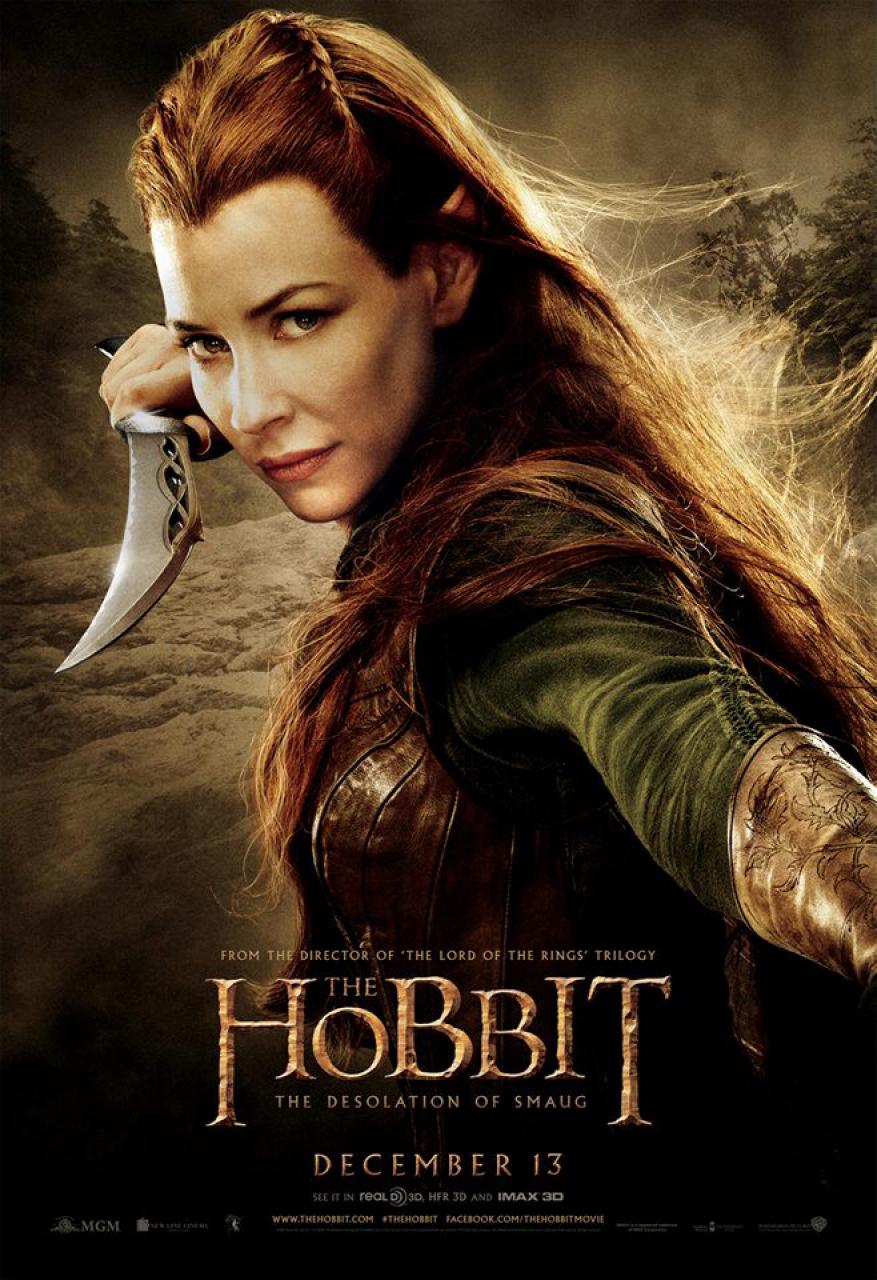
  • And then naturally Tauriel shows up. Look, I'm sorry about this, Tauriel, I really am. I wanted to like you. I overlooked your less-than-original relationships with Kili and Legolas all through Desolation of Smaug. I reveled in your action scenes and tried to forget what I didn't like about you. But after that death scene with Kili and Thranduil, I am done. 
    (See? Peter Jackson can't even get me to like a character that I wanted to like.)
  • Finally, I feel like the titular battle was far too drawn out. I get that it was an integral part of the movie and junk, and sure the action was fun to watch, but eventually it gets to the point where you're just wondering when it's going to end. 
The Hobbit: There and Back Again
  • I'm... not really sure how to feel about the Hobbit movie trilogy. On the one hand, there are--were--things I wanted to see in movie format. I was excited about the scene at the beginning of Desolation of Smaug, where Thorin and Gandalf first meet. I was happy to see all thirteen of the dwarves in the company fleshed out and represented. And of course, the visual shots are amazing, the action is fun to watch, and there's a decent bit of humor here and there too. 
  • But then there are the downsides. And there are quite a few downsides--most likely enough to outweigh the good.
    To begin with, there are the chronological errors. My biggest problem with the series at this point is that Azog the Defiler is still alive. According to Middle-Earth history, Azog was killed at the Battle of Anulzibzar Moria by Dain, Thorin's cousin. Azog's son Bolg--who also appears in the movie trilogy--was the one who spearheaded the orcish attacks, because Azog was, y'know, dead at the time. So here we have Peter Jackson messing up history on two accounts--one, Azog should've died at Moria, and two, it should've been Dain that killed him.
  • The whole Necromancer/Sauron subplot--which I have complained about before--was not, as I originally thought, wholly fabricated by Jackson. The White Council did, in fact, drive Sauron out of Dol Guldor and into the Mordor area, in the same year that Erebor was retaken. However, this doesn't mean I'm willing to let the matter pass. I do not think that such a storyline should have been included in the Hobbit movies, particularly when it had nothing to do with any of the main characters. The only thread connecting that story to the main one was Radaghast, and it was a tenuous thread indeed--since Radaghast wasn't involved in The Hobbit to begin with. 
  • My final main point about this series was Tauriel. As stated above, I wanted to like Tauriel. I really did. But with all that happened in the movies, I couldn't. I'm not sure if it was the screenwriter's fault, or Mr. Jackson's, or both, but I just don't feel like Tauriel brought anything new to the table in terms of... well, anything. Yes, she was action-y. So was literally everybody else. Yes, she provided romance. I wasn't particularly looking for romance in these movies, not gonna lie. And really, when it comes down to it, I just didn't feel too much personality from Tauriel. Which is a shame, because I wanted to like her. 

Conclusion

Well, this concludes my reviews of the Hobbit trilogy (much as Battle of the Five Armies concluded Jackson's Tolkien movies). We've been through the good, the bad, and the ugly, and if you've stayed with me this far, thank you. I appreciate that. 

Ah, well. I'd better not get too sentimental. I've still got plenty of things to obsess over and talk about on my blog. And with school coming up fast (faster than I'd like), there's that, too. 

So. I'm giving the Hobbit trilogy three stars out of five, for the sake of things. 


And that's the end of that. 

Wednesday, December 3, 2014

A Friendly PSA: Introverts, Extroverts, Ambiverts

So I've been thinking lately, and I've decided that it's about time I had a blog post about introverts, extroverts, and ambiverts. (I bet you've never heard about that last one. Well. What else am I here for?) If only because I am an introvert, and the matter has been keeping my attention lately.

And so: a friendly PSA.


#1: Introverts

Introverts are, quite simply, people who draw energy from being alone. Like most things, this is a spectrum; some introverts absolutely hate to be around other people; others don't mind social interaction, and might even like it, but will need a recharge period afterward.

Introverts are often misunderstood or misconstrued as snobs, 'weirdos', or recluses. The reality is we like people as much as the next; we just run out of energy and need to recharge by being alone.

Notes: I am an introvert. I've been known to have trouble interacting with people, because I'd often rather read or write something than talk to someone. Awkward chatting situations abound for me. I have been known to ecstatically dance around the house after visitors leave--not because I'm glad they're gone, but because the house is finally quiet and I can go read something now.

#2: Extroverts

Extroverts are people who draw energy and recharge by being around people. Again, there is a spectrum here, and it varies.

Extroverts tend to be better-liked than introverts, at least initially, because most extroverts can actually carry on a conversation with people they don't know.

Notes: I'm... not exactly sure what to say here, since I'm not an extrovert. So I'll just point out that neither extroverts nor introverts are more important or better. They both have things to contribute.

#3: Ambiverts

Ah, yes. Ambiverts. This side of the spectrum is the side that's almost never talked about, and I'm not sure why. It's very interesting.

Ambiverts are people who display traits of both introverts and extroverts. They enjoy social interaction, much more than most introverts do, but they need a solitary recharge period as well. Because they display traits of both, they may sometimes be pidgeon-holed into one of the other categories.

Notes: My sister is most likely an ambivert, leaning toward the introvert side of the spectrum. She loves spending time with her friends, but doesn't like spending time with people she doesn't know well. And sometimes, she just wants to be on her own.

And Now: A Conversation Between an Introvert, an Extrovert, and an Ambivert

Extrovert: Hi! How are you doing?

Introvert: Um... hi. I'm good.

[Silence.]

Introvert: Oh, um, how are you doing?

Extrovert: Good. What are you reading there?

Introvert: Oh, um, Lord of the Rings. [Looks back down at book.] It's really good...

Extrovert: Hi there, Ambivert!

Ambivert: Hi! Did you like the school assignments this week?

Extrovert: Not really, but I...

Introvert: [Quietly gets up and walks away]

[10-15 minutes later]

Ambivert: [Walks over and sits down next to Introvert]

[Silence]


...And that (hopefully) sums up the differences between introverts, extroverts, and ambiverts. Of course, I'm far from an authority on the subject. If you'd like to know more, I'd encourage you to research it. It's really a fascinating subject.

Questions? Comments? Critiques? Feel free to leave a comment in the comments section.

And that's all for now!

Saturday, November 1, 2014

Warriors: Bramblestar's Storm

*Warning: The following post contains spoilers. You have been warned.*

So I recently (well, sort of recently) finished Bramblestar's Storm, the latest in the (long, long) line of Warriors books. While it certainly wasn't my favorite in the Warriors series, it was pretty good overall, though I had a few small problems and one major bone to pick with the ending.

So here we go with the review.

***

Bramblestar's Storm: The Good
  • The plot was good. Warriors has always been a survival story--that's pretty much the baseline setting--but the titular storm in this book brought the 'survival' part to a whole new level. Much of the book dealt with the cats being forced to find a new (temporary) home, deal with loss of territory, etc. 
  • I appreciated the new characters. For one thing, they were all well-defined, with personalities different enough that I could easily tell them apart. Frankie/Stormpaw, in particular, was a favorite of mine. 
  • The aftermath of the battle in The Last Hope was shown and discussed. I was disappointed that Hazeltail got killed off (she was one of my favorite background characters), but I did appreciate the follow-up. 

Bramblestar's Storm: The Bad
  • The 'prophecy' Cloudstar gave to Firestar (who then gave it to Bramblestar) was totally useless. Because there was a prophecy involved, I kept expecting a boss-level villain to pop out at the end to be fought. The actual answer to the prophecy--Bramblestar's bond with his sister remaining strong despite Clan differences--was an issue that had already been discussed. Frankly, it was anti-climactic and made the prophecy seem needlessly confusing, vague, and distinctly unhelpful. 
  • I'm not sure what the writers intended for the Bramblestar/Squirrelflight/Jessy love-triangle, but whatever it was, they didn't do it right. I'm not a fan of love triangles in general, but there is a right way to do them. The triangle in this book seemed vague and oddly paced. The writers spent a lot of time setting up Jessy's involvement in the Clan. Then Bramblestar went on a few quasi-romantic dinner dates walks with Jessy... and then he decided that he wasn't in love with her after all; he wanted to be with Squirrelflight? Huh? When did you ever say you were in love with Jessy in the first place? And hadn't you made up with Squirrelflight already, when you made her your deputy at the end of The Last Hope?
    Like I said. Confusing. 
  • This is probably the biggest spoiler of them all, so skip this whole point if you don't want to hear it.
    *
    *
    *
    Alright, so the reveal at the very end that Squirrelflight really can have kits?
    I hated that.
    If you want a happy couple with a romantic happy ending, there are plenty of those to go around in Warriors. In my opinion, it was interesting and different to have a character who was barren. I was perfectly ready and willing to see Squirrelflight as a happy grandmother with no kittens of her own, who helped raise her adopted grandkits and nieces and nephews and such. Why do we need to bend and rewrite things that have already happened, just so we can have another happy ending?
    And it goes beyond that.
    What are you trying to say here, author? That no matter how much you're in love, it's not a real marriage unless you have kids? I'm sure that's not what was intended, but it kind of came across that way. Because even though there are hundreds of mother characters in Warriors, we couldn't let Squirrelflight represent those who are barren.
    That disappoints me. 
***

Bramblestar's Storm: The Conclusion

Well, I have mixed feelings about this one. On the one hand, It was pretty enjoyable in general. It was definitely better than Yellowfang's Secret, a previous Warriors Super Edition. I even enjoyed it more than Tallstar's Revenge, the Super Edition before this. But it wasn't the best Warriors book ever, and the aforementioned 'twist' at the end left a bad taste in my mouth. So I'm giving this one  three stars out of five:


***

And that concludes this review! 

My Halloween post is coming... soon... so stay tuned! Bye now!

Friday, June 13, 2014

A Layover-PSA-Update Type of Thing. [Or: Fireheart is really starting to annoy me.]

Alright, well, I finished re-reading Forest of Secrets (book 3 in the original Warriors series). And it was pretty good. Not my favorite, but it was pretty good. Did I mention that I like the OS because of its simplicity and tendency not to overexplain? The later Warriors books were good, don't get me wrong, but they explained way, way too much about StarClan. (And the Dark Forest, and the medicine cats...) Blah.

Okay, mini-rant over. Now that that's out of the way...

I've finished Forest of Secrets (and posted the first in a review series for Warriors); I think I already said that. I'd like to do the next part of that review series, focusing on The New Prophecy arc, but I think I should reread a couple books from that arc before I do. So that review probably won't be out until, say, next week. Maybe a little later. There'll probably be post between this one and the next Warriors one; they'll just be about different things.

Not that anyone will mind, I think.

Anyway. Yeah. That's what I wanted to say.

Also, Fireheart is getting kinda annoying, because all he can think about is Tigerclaw being EVIL, but nobody else knows, and I really want more ambiguity with Tigerclaw, and Fireheart, I wanna! And the other book I'm reading right now isn't helping!

Okay, now I'm done. 

Tuesday, June 10, 2014

On Cats [Review for Warriors, Part 1]

*Warning: Unmarked spoilers may follow. Viewer discretion is advised.*

Well, what with the arrival of The First Battle (the third book in the Warriors: Dawn of the Clans arc, and something like the twenty-seventh Warriors book overall) I've been re-reading some of the books in the Warriors series. Not all of them, mind you, but some. And I decided that since there are plenty of pros and cons to this series, I might as well review it.

So here goes.

***

 Today, I'll be reviewing the first Warriors arc, often called the Original Series. Each arc has six books; the Original Series (or OS) contains Into the Wild, Fire and Ice, Forest of Secrets, Rising Storm, A Dangerous Path, and The Darkest Hour. The OS centers around the tale of Fireheart, a former kittypet (house cat) who runs away to join ThunderClan and quickly finds that the forest is more dangerous than it appears.

Good/Favorite Bits:

  • The simplicity. Reading back over the OS, I'm realizing just how much simpler it is than the later arcs. The third and fourth arcs probably have about fifteen different subplots between them. The OS is by no means completely free of subplots, but it's remarkably focused on the one main plot. (Maybe a little too focused, but we'll talk about that later.) 
  • The simplicity of viewpoint characters. As the books go on, they gain more and more viewpoints. The second arc has, I think, 2-4 viewpoint characters, depending on the book, the third arc has 3 viewpoints, and the fourth arc has a grand total of 4 viewpoints. The first series, by contrast, has one viewpoint character and only one. But it also introduces characters who will be crucially important later, such as Fireheart, Bluestar, Yellowfang, Graystripe, and more. 
  • The worldbuilding. The cats have almost an entire vocabulary of their own. They have names for seasons (leafbare, newleaf, greenleaf, and leaf-fall), names for humans and automobiles (Twolegs and monsters, respectively), plus legends, traditions, and their own way of living. 
  • Realisticness. The later arcs--#2 & #3 in particular--tend to humanize the cats quite a bit. There's humanization here, but it's less intrusive; the cats act more realistically. 

Bad/Least Favorite Bits:
  • Infodumping. You might not catch it on the first read--I didn't--but it's almost as if the author feels she needs to insert a PREVIOUSLY, IN WARRIORS paragraph into each book so the readers aren't lost. Just in Forest of Secrets (book 3), I've been reminded at least once that Bluestar let Fireheart into the Clan even though he was kittypet (house cat), Cinderpaw broke her leg in an accident on the Thunderpath (an asphalt road frequented by cars), Yellowfang is Brokenstar's mother, Spottedleaf died, Graystripe is in an illicit relationship with Silverstream... on and on it goes. And I know all this already. It would be a lot better to weave such information into the dialogue and/or narrative. 
  • Clichés. The OS isn't the most cliché story I've ever read (that honor goes to My Little Pony: Equestria Girls), but it has its issues. Character archetypes, for one. Fireheart is the hero. Tigerclaw is the villain. Graystripe is the plucky sidekick. Bluestar is the doomed mentor. Spottedleaf is the equally doomed love interest. Sandstorm is the feisty other love interest whom the hero will become happily married to in the end. And all of this is pretty easy to tell from the first book alone. (Well, Sandstorm's role isn't crystal-clear until book two or book three, but still.)
  • This is more of a personal thing, but I wouldn't mind a touch more moral ambiguity. Something that annoys me is that Tigerclaw is pretty much 100% EVIL, all the time. The only time he's not being EVIL is when he's pretending so that the Clan doesn't find out how EVIL he is. And of course, Fireheart is the only one who even suspects that Tigerclaw might be EVIL. 
  • Conversely, Fireheart is an almost perfect main character. All of his perceptions match perfectly with what's reality--which they shouldn't--and even though he occasionally he slips up, such slip-ups are almost always made as a result of too much kindness, disregarding tradition in the name of compassion, or something like that. Unless, of course, it's Tigerclaw trying to frame him or blame something on him because he's a former kittypet and Tigerclaw is a racist bigot. I mean, if he actually gave Fireheart a sporting chance before he turned against him, however would we be able to tell that Tigerclaw was EVIL?
    #sarcasm
Conclusion:

The Original Series has its upsides, but it definitely has downsides too. I'll always be a bit nostalgic for the OS and its simplicity (not all character archetypes are bad, after all...), but overall, it's not my favorite Warriors arc. So I'm giving it three and a half stars:


***

And that wraps up my review of the Original Series! Next time, we'll go in-depth on the second arc--Warriors: The New Prophecy. Don't miss it!

Bye, and thanks for reading!

Sunday, May 11, 2014

Suspension of Disbelief is Great, But There Are Still a Few Sci-Fi Explanations That I Will Never Use

So I recently went to see Captain America: The Winter Soldier again. And it was great--awesome, in fact--but that's not what I'm here to talk about today.

Today I'm here to talk about one of the previews that accompanied the movie.

I won't go into the details, but basically it was appeared to be a dark sci-fi action type of movie. The premise was, more or less, "Humans only use 10% of their brains, so what happens when someone unlocks more of their potential?"

Which is great, and all that, except... "Humans only use 10% of their brains" is a myth.

Humans actually use 100% of their brains, though different parts are active at different times. Actually, using every part of your brain all at once is generally called a seizure.

So that brings me to my topic for today: "Top 5 Sci-Fi Explanations That I Will Never Use In a Book".

5) "Gamma radiation is capable of causing helpful mutations"

Um... no, actually, I'm pretty sure that gamma radiation in high doses just kills you. According to Wikipedia, it can also burn you, cause DNA damage, kill cells (because of said DNA damage), and cause radiation sickness.

And contrary to popular belief, damaged DNA doesn't give you superpowers either. Actually, that brings me to #4...

4) "Helpful genetic mutations exist"

No, actually, they don't. 99% of known mutations are very harmful, sometimes even lethal. And the only helpful mutations documented are those that provide heightened levels of immunity to diseases.

Sorry, X-Men.

3) "The spaceship has a lightspeed drive/can go the speed of light"

Do you have any idea just how fast light goes? In case you were wondering, it's 299,792,458 meters per second. That's 186,000 miles per second (with some rounding), or about 671 million miles per hour. Additionally, we in the early 21st century have no idea how to replicate anything close to that speed. Sorry, but I'm not buying it.

Side note: I will, however, accept the "relativistic speeds" explanation used by Orson Scott Card in Ender's Game. That's based on an actual theory, and it doesn't imply or state that humans are trying to go the speed of light.

2) "This galaxy just happens to have [insert number here] Earth-like planets"

This one sounds good initially, but wait a second. Earth is, quite literally, one-in-a-million. Earth has just the right star, just the right placement, just the right tilt, just the right rotation, just the right moon, just the right orbit speed... I could go on, but you've probably gotten the idea. I can't remember the exact chances of Earth's specific qualities randomly occurring, but they're pretty freaking low. We haven't even found water on any other planet, and most planets are downright hostile to the mere idea of "life".

I'm not saying you can't have Earth-like planets, but I'd just like to point out that the vast majority of planets aren't going to be Earth-like. At. All. And there will probably be a limit of one Earth-like planet per solar system, since there's only one specific distance that a planet can be from the sun to keep from burning up or freezing.

In short, if you have an Earth-like planet, chances are every other planet in the system will be hostile, to some degree. So can we be realistic about it, please? (Star Wars, I'm looking at you.)

1) "The characters are in trouble because the starship ran out of fuel"

So why isn't the ship still moving?

Space is a void. It has no air, no friction, and no gravity (unless you manage to hit the gravitational pull of a planet or other large body). In space, Newton's first law of motion applies quite literally: An object at rest tends to remain at rest; an object in motion tends to remain in motion, unless an outside force acts against it.

Get something moving in space and it won't stop, unless you happen to hit an asteroid or something like that. A spaceship doesn't actually need all that much fuel--it just needs enough to get it moving. The real problems are a) the amount of time it takes to get anywhere worthwhile in space, and b) the amount of food a human crew would need to get anywhere worthwhile in space (hence the "light drive" and "relativistic speeds" explanations).

On the upside, though, this does mean that there's no need for gas stations in space...

------

And there you have it. 

Please note: I'm not trying to spoil anyone's fun when it comes to science fiction/superhero stories/whatever. I'm not. Really. I do enjoy The Avengers, even though they have a gamma monster on the team. I haven't had a chance to get into the X-Men yet, but I'd like to, even though they violate Rule #4 (like, a lot). I'm even a fan of Star Wars, even though they've pretty wantonly laid waste to Rules 1-3. So I'm not trying to ruin anything for anyone. I'm just... venting, I guess. Sorry.

But I can promise you that I'm never going to use "genetic mutation" as an origin story. So there.

Wednesday, April 23, 2014

I Have a Problem with Characters Getting Killed Off

*Warning: May contain spoilers.*

Okay, well, this blog post may or may not have been influenced by the third-to-last episode of Avengers: Earth's Mightiest Heroes. But really, it's a problem I have with stories where characters die in general. So basically, everything except My Little Pony.

But anyway. I have a serious problem with characters dying in stories. Especially if it's a tearful, melodramatic death scene. As I like to say, you should've seen me during Crookedstar's Promise. It was one giant tearfest.

I don't know exactly why I don't like character death scenes. Maybe it's because I'm a (mostly) normal human being. Actually, it's probably because I'm a mostly normal human being. It might also be because I've seriously scared myself by imagining what I would do if it was me and my sister in the place of those two characters. If my sister got hurt? If, God forbid this should ever happen, she died and I couldn't stop it? If I hurt her? (*coughFrozencoughcough*)

Scary, as I said. So maybe that's the elusive reason.

But my adverse reaction to touching character death scenes is also rather odd. Why? Well, you see, if I'm totally honest, I can be rather sadistic to my fictional characters.

Seriously. It sucks to be one of my characters. If you are one, well, first of all, stop reading this blog. I know where you live. [See? See?] And secondly, run for the hills and don't look back. And hope you don't get captured by elves or eaten by a dragon.

All that to say, a lot of the time I can watch/read/write a character death with something pretty similar to indifference. Other times (*coughcoughWarriorscough*) I melt.

And sometimes I just stare at the screen in shock and horror as one of the characters--one of the heroes--melts before my very eyes.

GOSH DARN YOU EMH SCRIPTWRITERS IF BLACK PANTHER DOESN'T COME BACK SO HELP ME--

Ahem. Please excuse the caps rage, that death scene was rather traumatic for the cynic living in my head.

So yeah, all that to say, I don't like character death. The more I like the character, the less I like the death.
We will always remember the Black Panther.

Ah, not really. He's back now. See? No one ever stays dead in these kinds of shows. 

Tuesday, March 25, 2014

So You Think You Can Annoy the Fans?

Twilight Looking Up and Smiling EG
Every MLP fan's worst nightmare...
If you've read my review of The Hobbit: Desolation of Smaug, you probably know that I don't take kindly to anyonebe they movie director, novelist, or anyone elsemessing with my favorite books and movies. Neither do I appreciate the corruption of a franchise I appreciate, such as My Little Pony: Friendship is Magic. 

So, with that in mind, here is a top five list of adaptations, sequels, or thinly veiled marketing ploys spinoffs that I did not appreciate. 

***

#5: The Hobbit: Desolation of Smaug
I have already taken the liberty of reviewing this atrocious creative movie, so let me just sum up my opinion as this: I didn't like it. The movie in and of itself had some nice moments, and while I didn't appreciate the overtly dark tone, it was overall a pretty fun outing. 

However. 

In the context of being a book adaptation, it was horrid. Almost nothing went according to the original work, characters and backstories were added willy-nilly, and almost half an hour (by my estimate) was spent on a superfluous scene that could have been avoided if the director had just taken the time to expound on the things he should have.

So I didn't like it.
(Please note that the first Hobbit movie, while liberal, was good enough to earn a reasonable rating from me. The second one wasn't. As of the writing of this post the third one hasn't yet been released, but at this point my hopes aren't that high.)

#4: My Little Pony Equestria Girls: Rainbow Rocks
This one hasn't been released yet, but it's on the list purely because there's a 99.5% chance that it will be just as terrible as its predecessor.

Which leads me to...

#3: My Little Pony: Equestria Girls
I've already linked to the Wikipedia article in the picture at the top of this post, so I'll be brief here:

I don't like Equestria Girls because it's cliché. I don't like Equestria Girls because it's childish. It's generic. It's boring. And it ruined a part of the My Little Pony franchise for me.

Now, don't misread me. I like My Little Pony: Friendship is Magic because it's the opposite of all the adjectives used to describe EqG above. But Equestria Girls? It was terrible, and frankly I think Hasbro sold themselves short. A My Little Pony movie could have been so much more.

#2: Superhero Squad
Oh the horror...

Okay, so this show is (hopefully) supposed to be a parody. Which I didn't know when I tried to watch it. So I probably ended up taking it way too seriously... but still.

This show is just... stupid.

Seriously, that's all I can think of to describe it. The characters are all one-dimensional to the point of being out-of-character, the villains are that plus being clichéd and brain-dead. And there are no alter egos.

So no Tony Stark. No Bruce Banner. No Carol Danvers, Peter Parker, or Steve Rogers. I didn't know how much I loved alter egos until they stopped being there.

 And there is absolutely no character development what. So. Ever.

Conclusion: If you intend to venture out into the juvenile depths of this show, be prepared to take it with a boulder-sized grain of salt.

#1: Disney's Pocahontas
Admittedly, I had a surprisingly Disney-free childhood. To this day I haven't watched a number of their princess movies, though I do tend to like the ones I have had. So that may contribute a bit of bias to this opinion.

But still...

Disney's adaptation of Pocahontas affronted me, mostly because they, apparently, thought they could play fast and loose with the historical facts. Here's a tip: if you don't think X will make a good movie, then just don't make a movie out of it! But don't, for the love of caramel corn, rearrange facts and redesign characters willy-nilly to accommodate your ideal of the movie!
My other major problem with this movie was its characterization. Both of the main characters were two-dimensional at best, and so was the villain and the one of the two supporting characters. The other supporting character did happen to have some halfway-decent characterization, and he ended up being the only reason I finished the movie.

Conclusion: It's a sad, sad, time when you're watching a historical fiction movie... and end up only finishing it for the sake of the one completely fabricated character.

***

And there you have it! Five complain-y mini reviews, all for the price of one!

Tune in next time to hear me complain about even more stuff!

Or maybe review Star Wars: The Clone Wars. I'm not sure yet. 

And that's all for now, folks!

Friday, February 14, 2014

The Hunger Games Ruined My Vocabulary

First off: right, yes, I know, I promised a review, but this one popped into my head and I had to run with it. Reviews are coming. Soon. Eventually. As soon as I get at least one of the books on my current reading list finished.

Now.

The Hunger Games ruined my vocabulary.

It's not just the Hunger Games, of course. A lot, and I mean a lot, of stories all conspired to ruin my vocabulary. Every fantasy/sci-fi story I ever read/watched was probably in on it. Probably the only books that weren't involved were that pesky Real Life series by Nancy Rue. (And when I say pesky, I mean so-awesome-you-should-totally-go-read-them. Like, right now. Or at least after you finish reading this blog.)

So anyway, it would take a lot of time to list all of the conspirators. For convenience I'll just list the worst ones here.

To start, the Hunger Games.

The Hunger Games ruined me because I can no longer hear the word "games" without immediately thinking of gladatorial combat. Seriously, just go ask Rainbow Dash why I want the Equestria Games to involve combat.
(Not that I'm not totally excited for a ponified version of the Olympics, but that's a different blog post.)

THG also totally ruined the word "career", along with "glimmer", "clove", "primrose", "rue", and especially "katniss".

Next up, Star Wars.

Star Wars ruined "master". Totally, utterly, completely. Also "knight", along with "system". (Though I at least understand the reasoning behind that one, so it works. But still.) And I'm not even going to go into "imperial" and "senate".

I could go on, but you probably get the picture. It's a conspiracy, I tell you, and the ringleader is none other than the troublesome mental phenomenon known as word association! It's a conspiracy, they're conspiring against me! Treason! Thieves! Fire! Murder!

...Sorry. Got a little off-track with that one.

But it gives me a great idea.

Someday I'm going to write a story about an elf who's divergent from her system's way of doing things. She goes on a quest with her master, and on the way they meet a knight of the Celestial Order who possesses a magical primrose flower known as the Rarity, and a cat-shifter morrowseer, gifted with foresight. Together they must avenge all of the dwarves killed by the Dark Lord Maul.

And it will be epic.

(Bonus points to the max if you can name all of the references that weren't name-dropped in this post.)

Again, stay tuned, because reviews are coming! Eventually. 

Tuesday, February 4, 2014

What Not To Do


Or, Fictional Stuff that Really Ticks Me Off.

***

Well, I wanted to start a series of reviews for books and movies I like, but since I'm on vacation that'll have to wait. So instead, you lovely people get a rant.
Also, I'm on my tablet, so feel free to point out any typos you see.
Anyway. On we go. (Links will be provided when appropriate.)

1) Female warriors with waist-length hair.
Tauriel as she appears in Peter Jackson's
The Hobbit: Desolation of Smaug
Natasha Romanoff/Black Widow,
as seen in The Avengers: Earth's Mightiest Heroes
This one is first because it really bothers me.

To start, I'm going to say a few things about myself. I'm a girl, so my hair is long but not really long. A few inches past my shoulders, at the longest. I keep it in a ponytail 90% of the time because it gets in the way if I keep it down. If I happen to be playing a sport or running around for some reason,  I'll definitely put it up, or even braid it.

So tell me: where is the logic in having loose waist-length hair if you're consistently going to be in a high-risk combat situation?

Answer: there isn't any. Hair that long could very easily get tangled, pulled, yanked out, caught on something, etc. Ever heard the story of Absalom? In case you haven't, he died because his long hair got caught on a tree branch, allowing him to be overtaken and killed.

Killed.

My Solution: Braid. Your. Hair. You want to look attractive and actiony? Well, that's asking for a lot, but that's a different blog. The point is, braid your hair. You get to keep it, and as a bonus it won't endanger you by getting caught so easily.

2) Gamma radiation is not a one-way ticket to super powers.

"That much gamma exposure should've killed you."
–Tony Stark on Bruce Banner's transformation into the Hulk (The Avengers, 2012)

This one came up because of two episodes the Avengers: Earth's Mightiest Heroes series. The basic premise is this: a super-intelligent supervillain plots to take over the world (yawn) by enveloping the entire planet in a dome of gamma radiation, thus turning everyone inside into monsters.

Well, hate to break it to ya, Mr. "Leader" (I'm not kidding. That's his name.), but that would just kill everyone. Really. It would only be you and all those other weirdos from the specialized gamma radiation prison. Because you see, the sad reality is this: gamma radiation doesn't really turn people into monsters. It just... kills them.

I can hear the skeptics now. But you don't have any problem with the Hulk, and HE'S a gamma monster! Explain that one!

Alright, I will.

The thing is, Bruce Banner is one person. One person out of―I don't know―7 trillion people? And I'm willing to believe that that one person might have a specific genetic anomaly that might coincide with a specific level of gamma radiation to create the Hulk.

I am not willing to believe that it'll work for everyone.

My Solution: Um... I got nothing. Just don't use this backstory more than once, I guess.

3) Is it just me, or are humans the least developed, least advanced species ever to exist?

This one I'm dividing into fantasy and sci-fi, since it applies to both.

Fantasy:
Here you have elves (in tune with nature, awesome fighters, or both), dwarves (long-lived, sometimes with earth powers or metal-working powers to boot), dragons (They can breathe fire. 'Nuff said.), and any other fantasy creature you might want (including but not limited to: fairies, gnomes, orcs, hobbits, and shapeshifters). Whichever way you go, you've almost always got creatures that are more powerful, more long-lived, and generally all-around cooler.

Sci-Fi:
There tends to be more freedom of imagination here, but the basics are the same―nonhumans have longevity, six or seven senses, two brains, the ability to regenerate limbs, etc. Whereas humans are just... humans. Additionally, any extraterrestrials usually have technology that blows ours out of the water. 

Now, if you'll notice, the only thing all these fictional species tend to have in common is that they're all, to some degree, better than humans.

Now, I can see where the writers are coming from from their standpoint―if I'm going to use a nonhuman I might as well make them cool, and also different enough to be called nonhuman. But from a fictional standpoint, this is downright embarrassing. Because basically, if you're a human, you're automatically at a disadvantage.

My Solution: Either give the humans some unique abilities of their own, or limit the elves/dragons/shapeshifters/whatever.

4) Contrary to popular belief, it can be extremely hard to learn a new language.

The most egregious offender I know of for this one is probably Eragon. Not only did the titular protagonist learn to read in a week, he also learned a magical second language with minimal fuss or difficulty.

That is not the way things work, ladies and gentlemen.

I'm currently five months into a study of Latin, and I am no conversationalist in that tongue. I have a long way to go. Additionally, I'm in my early teens, and as far as I know my ability to learn a language is already declining. The protagonist of Eragon is two years older than me.

My Solution: For the love of StarClan, be realistic about these things. Don't make it easy, because it's not.

5) There is a thin line between "letting your heroes get off scot free" and "using every other character to blame the heroes for the collateral damage".

For that matter, there's also a line between "having everyone shower your heroes with praise" and "having everyone ignore the heroes... even after they've saved the world".

This is something My Little Pony: Friendship is Magic tends to err in. The Mane Six have saved the world three times (four if you count the Equestia Girls movie, which I don't). Yet we see in multiple episodes that no one seems to know who they are.

Superhero movies also tend to mess up with this. One of the things I like about the 2012 Avengers movie is that it shows a healthy balance here. Sure, some people are asking questions and wondering why the Avengers had to destroy half of New York in their battle. But others are thankful and frankly that's refreshing.

Actually, this leads me to another point...

6) Slandering the guy who can warp the fabric of atomic energy is a BAD IDEA.

Sure, some heroes will do the right thing and keep on saving people, even when they get no respect in return. Sure, some heroes will put up with all the verbal abuse. Some, on the other hand, wouldn't and won't.

Think about it, Mr. Outspoken Newspaper Editor. Do you really want a world where Generic-Man decides to quit his job because he can't catch a break? Do you really want some savvy villain to take advantage of your lies?

Heck, if I were a superhero getting razzed by the local newspaper, I might take a stroll over there and give 'em a piece of my mind. I might even fry some stuff. Sure, Spiderman and Captain America might put up with it, but I'll bet you Iron Man and Thor wouldn't.

My Solution: You don't need to eradicate J. Jonah Jameson and his ilk. They need scapegoats. I get it. That's always been a problem. But please, at least show the people who do care and are thankful. I know they exist, so give them a voice. (This also applies to #5.)

***

And there you have it. Some of the things that majorly bother me, and how they can be avoided. Next blog will be a review, I promise.

A Short PSA: Thanks to a quick bit of tinkering, anonymous comments are now enabled, meaning you can comment without needing a Google account. Just thought I'd mention it.

Wednesday, January 8, 2014

The Hobbit: Desolation of Smaug

*Warning: The followed blog contains massive spoilers and unearthly amounts of ranting. Viewer discretion is advised.*

Dear Peter Jackson,
I'm writing this letter to express my complaints about your recent film "The Hobbit: Desolation of Smaug". I have many complaints, and hopefully this letter will reveal to you the depths of my disappointment.

As stated, I have many complaints, but I believe I will start with the beginning of the movie.

Your opening scene with Thorin and Gandalf was excellent. Something I looked forward to for a long time. Let it never be said that Desolation of Smaug has a dull opening.

But then came the next scene.

It opened well enough. Bilbo doing surveillance, the dwarves being chased, and so on. But herein lies my first question: we ended The Hobbit: An Unexpected Journey with the dwarves having been rescued by eagles. They were resting, safe, on the Carrock. What happened? Was there a timeskip? If so, why is this not clearer?

Anyway, the dwarves start through the forest, after Gandalf tells them that they're on their way to meet a shapeshifter. Said shapeshifter is nice enough when human, but rather animalistic in bear form. Oh, and it's hit or miss, you might catch him human and you might not, so let's run to his house and hope to high heaven he doesn't catch us on the way.

Oh, and there are orcs. Of course.

So they make it to the house, and apparently Beorn (the shapeshifter) isn't strong enough to break down his own doors.

Even in bear form.

So the dwarves get some much-needed rest. A bit later Beorn comes in in human form and serves breakfast... as he tells the tale of how he is the last shapeshifter, that they were all killed eventually by The Necromancer.

Dear Peter Jackson: What the heck? In the book Beorn's origins were speculated on, but never really explored. And then I see you spinning all this nonsense about a race of skinchangers that were captured when goblins and orcs came from the north. And then torture.

I don't think anyone really wanted breakfast after that little story.

Anyway. Moving on.

So Beorn and Gandalf warn the dwarves about the Mirkwood, yadda yadda yadda. They go to Mirkwood... and Gandalf discovers a mysterious sign that somehow portends evil. So his decision not to join the dwarves in Mirkwood is split-second, not premeditated.

Book deviation count: 5

Now, I'll consider what happens next a timeskip for your sake. The dwarves start well enough, but then lose the path and start wacking out. Illusion, mind games, and such.

In the book they deliberately left the path out of hunger, not madness. Book deviation count: 6

And then spiders. Bilbo is considerably awesomer than he was in the book. Dwarves are considerably stronger than they were in the book. A nice, book-oriented scene is ruined thanks to spiders.

And then the wood elves show up, and we get a first glance of Tauriel, much-famed female wood elf. And I must admit, she's awesome.

Except for the fact that she shows up... to save Kili.

Ordinarily I would rejoice at this. Female warrior and favorite dwarf together in one scene! But not so. And we shall see why... soon enough.

Anyway, the dwarves are marched to the wood elf palace and locked up. Some rather flirtatious dialogue is had between Kili and Tauriel. And then we cut to Thorin and Thranduil.

Admittedly, I was waiting for this. A scene I so wanted to happen. And at last, something goes right: Thorin starts yelling at Thranduil for his betrayal (if that's what you want to call it) that we saw in the first movie.

Thranduil retorts that he tried to warn Thorin's grandfather, what happened wasn't his fault, and he has seen things Thorin doesn't even know about--something about dragon fire, I think.

Dear Peter Jackson: What the heck? There's kind of a reason we have skin on our faces, you know. And you know what? I'm done. I really don't care if you can justify it anymore, I'm done. This is not the story we know and love.

But for the sake of possible better bits, I persevere.

Thorin is thrown in jail, possibly to rot, since "One hundred years is the blink of an eye in the life of an elf". Thranduil is dramatic if nothing else.

Thorin tells Balin of the deal Thranduil offered, and how he told Thranduil to go... um...

You know, I don't think there's even a way to translate that nicely, so I think I'm going to move on.

Kili is sitting in his cell, playing with this dark stone that has runes carved in it. Tauriel walks by, inquires, and Kili tells her that the runes will curse any non-dwarvish entity that reads them....

...And then decides that he'd really rather make friends with this nice (not to mention good-looking) elf. So he stops messing with her and they start talking.

While Legolas watches jealously from the shadows.

Book deviation count: 

Just to say, the chatty dialogue is nice enough... but you made your decision about this movie's level of darkness, Pete, and you can't have romance and dark action in the same movie without some very careful handling. This movie wasn't careful enough.

Moving on.

We then flip to the POV of Bilbo, who is sneaking around the elves' palace. He spies on Thranduil from the shadows as said elf king speaks to Tauriel about the giant spiders that are growing bolder.

Towards the end of their chat, Thranduil roundaboutly tells Tauriel that she is not to become romantically involved with his son, because she is basically not high-born enough.

So forbidden romance all 'round. Seriously, I thought this movie would be more original. But no.

Then we see Bilbo in the elves' cellar-rooms, where he discovers that the elves' empty wine barrels will be sent down the river to Laketown. So he steals the keys, lets the dwarves out, and packs them into barrels.

Now, allow me to back up a bit and explain something: back when the dwarves were at Beorn's house, a rather familiar orc by the name of Azog ordered a different orc--Bolg--to take up the hunt for Thorin, thus rehashing a lot of the tension seen in movie one. So this Bolg is hunting the dwarves, and he's about to catch up them via the river-gate.

You can see where this is going.

So the dwarves start down the river, with Bilbo hanging onto the side of one of the barrels, just as the elves discover that they're gone. Bolg and Co. show up and start trying to kill the dwarves. And since dwarves have, in fact, dropped to Enemy #2 since the orcs showed up, a massive orc-vs-elf battle ensues, with the dwarves in the middle of it.

Did this battle have great combat scenes? Yes. Did it have some other good bits? Yes. Did I like it? More or less. Was it in the book? No!

So the dwarves float down the river in the middle of a battle scene. Then they reach the river-gate that will allow them out of the elves' lands--and the elf shuts the portcullis right before being shot by an orc.

Dwarves are trapped as total orc-vs-elf pandemonium reigns. And then... our intrepid hero Kili realizes that he can, in fact, climb up to open the portcullis if he tries, danger and possible consequences be darned.

So he tries.

And he almost makes it, too. But just as he reaches the lever, Bolg takes aim with his bow and...

Now there's an arrow sticking out of Kili's thigh.

Book deviation count: 12

Long story short, the dwarves (including Kili) make their escape, and Thranduil decides to lock down the kingdom upon learning that some great evil has appeared.

Because putting everyone in lockdown always works when the world is at stake.

However, Legolas learns that before the lockdown order was given, Tauriel left the kingdom to go find Kili, after she learned that he was shot with a poisoned arrow. Legolas decides to follow her.

Book deviation count: 15

And then we flip back to the dwarves.

Our heroes have managed to make it out of the woodland realm and are resting on a riverbank. Their new main problem is discussed: they have no way of getting across the lake the river empties into, and Bolg and Co. would easily run them down if they tried to go around.

As this is being talked over, the shot zooms ominously in on Ori, who is innocently dumping water out of his boots.

Then he looks up.

And sees an archer poised at the top of a rock, ready to shoot.

Dear Peter Jackson: What the heck? I'm an avid reader of the book, and I'm pretty sure that's not how the dwarves met Bard. But then again, this movie hasn't exactly been a paragon of adherence so far, so I digress.

Book deviation count: 16

So the dwarves speak with Bard. Balin does his best to sweet-talk their new acquaintance into taking them to Lake-town. Eventually he succeeds, but only because he offered to pay double Bard's usual fare.

So the dwarves go to Lake-town, and Bard smuggles them into his house in a painstaking process that involves fish, latrines, and some mildly invoked threats. I have yet to understand why Alfrid and the Master have such a vendetta against Bard. What has he ever done to them? Exist?

Here I'll stop complaining to make a brief note: I like Bard and his family. I really do. If nothing else, they are the one accomplishment made in this movie. For me, at least.

And then, alas... something more happens.

Bard tries to hold up his end of the deal by securing weapons for the dwarves, but Thorin and Co. suddenly decide to be picky about their weaponry. They want iron weapons, the fact that all iron weapons in Lake-town are under lock and key be darned!

You can see where this is going.

Thorin and Co. decide to... break into the town armory and steal weapons.

Dear Peter Jackson: What the heck?

So they break into the armory and begin stealing weapons. It's actually going quite well. And then Intrepid Hero (aka Kili) comes down the stairs carrying an armload of metal weapons and trying to walk on a wounded,  poisoned leg.

Even worse, when Thorin (Kili's uncle) inquires, Kili claims he's fine, and gets a few more weapons to carry for his trouble.

Guess what happens.

Kili falls down the stairs, dwarves are captured, and Bard discovers that Thorin's appearance means not prosperity but destruction.

Thorin and Co. are marched before the Master, who seems more upset at being woken up than anything else. Before charges can be brought Thorin, being the amazing motivational speaker that he is, announces his identity and manages to convince the people of Lake-town that they will join in the wealth when Erebor is re-taken.

Bard arrives and tries to convince everyone of what he's discovered, but the Master discredits him by pointing out that Bard's ancestor was the one who failed to kill Smaug during the attack on Dale. Thus the dwarves get a proper welcome to Lake-town and there is much rejoicing amongst the townspeople.

A short timeskip is had, and the next we see of the dwarves, they're preparing to leave for Erebor--even though the group is notably lacking in a certain dwarf named Bofur. As the others board the boat, Thorin pulls Kili aside and breaks the news to him: He's not going with them to Erebor.

It's a logical decision--Kili is wounded and would only slow them down when they need to move fast--but it's also a decision that breaks Kili's heart. He and his brother (Fili) grew up on stories of Erebor and now...

Oin volunteers to stay with Kili, since he has healing experience. Fili, angry at his uncle's decision, defies Thorin and also stays behind.

And, of course, we have Bofur, who woke up late and missed the boat.

Dear Peter Jackson: What the heck? That's four dwarves not going with the others, one of whom only stayed behind because he... woke up late. Seriously? You'd better have a really, really good reason for this.

Anyway.

We flip back to Gandalf's POV, and find that he has come to an old, crumbling fortress. With some difficulty he gets in and goes to meet Radagast the Brown in a certain area. Here we learn that "the Nine" are gone, and thus The Necromancer (who is rising in the south Mirkwood area, at Dol Guldor) cannot be a human sorcerer, since "the Nine" only answer to one.

The Necromancer can only be Sauron.

And so Gandalf is forced to choose: rendezvous with the dwarves as he promised, or go to confront The Necromancer before it's too late?

Under some duress from Radagast, he chooses the latter and they set off.

At Dol Guldor, Gandalf sends Radagast to alert Lady Galadriel to what is happening. And then he goes in alone.

He explores a bit and attempts to expose the evil hiding in the fortress. These attempts are mostly futile, and thus he is caught off-guard when none other than Azog the Defiler attacks.

Dear Peter Jackson: What the heck? In case you need reminding, this is the wizard who took out a freaking balrog. The same guy who ended Theoden's possesion in the halls of Meduseld, who came with the rising sun to rescue Helm's Deep.

And he can't take out one orc?

I am done.

So Gandalf manages to keep Azog off his back, though he's nowhere near as good at it as he should be. He tries to escape, but is stopped by The Necromancer himself.

Gandalf casts a light-shield spell similar to the one he used in Moria, against the above-mentioned balrog. It... sort of works... but in the end The Necromancer is stronger and defeats him.

Okay, nothing wrong with that so far. When Sauron was at peak strength, the five wizards of Middle-Earth combined couldn't destroy him. He's at low power right now (as Gandalf handily pointed out earlier), but he should still be a match for a solitary wizard.

But now comes the bad part.

The Necromancer defeats Gandalf and pins him to a wall, using a wind-like force that seems to come with his swirling dark form. But then a figure clad in dark armor comes walking out of the flames, creating the famous eye of fire Sauron is known so well for.

Dear Peter Jackson: What. The. Heck.

As far as I remember, the last time Sauron had enough power to take on a human form like that was... the Second Age.

Even worse, he was only able to manifest himself then because he was at peak power and possessed the Ring.

Gandalf already pointed out that Sauron is currently at low power. So why the heck is he manifesting himself in a form he's only taken once before, at peak power?

Anyway, scene ends with Gandalf dangling over the side of a cliff in some sort of cage, watching in horror as orcs march toward the lonely mountain.

And with that happy thought in mind, we switch back to Thorin and Co.

Back at the Lonely Mountain, the dwarves refuse to wait for Gandalf at the assigned meeting place and strike out to find the hidden door. They do eventually find it, and wait in anticipation as the sun sinks, for the "last light of Durin's Day will shine upon the keyhole", and they need to find the keyhole to get into the mountain.

The sun sets.

Nothing happens.

The dwarves get depressed and make as if to go home, but Bilbo stays around. And as he stand there...

The moon comes out from behind a cloud and illuminates the door in just such a way as to show where the keyhole is.

The dwarves have penetrated Erebor. Finally.

In a way that never happened in the book.

So the dwarves send Bilbo into the treasury, and Balin explains that he's there to find the Arkenstone: a large, white gem that he'll know when he sees it.

Also, not waking the dragon would be a good idea.

And so Bilbo is left, alone, to work his nonexistant magic.

Bilbo sneaks into the treasure-room and searches for a while. But this treasure is huge--about as large as a medium-sized city, I'd say. Searching is all but futile when all the description you've got is "a large white gem".

Then Bilbo inadvertently wakes Smaug, and the two have a passably decent conversation... until Smaug tires of it and begins threatening Bilbo as only dragons can do. He knocks around a bit of the architecture in the treasury, and the resulting noise is heard all the way out at Lake-town.

Bard, being the perceptive, knowledgeable guy that he is, hears the noise and takes his black arrow--the one remaining weapon that can kill a dragon--and hurries to fix it to the dwarf-made bow that lies at the top of the city. Unfortunately, the Master and Alfrid really have it out for Bard now, and he ends up getting arrested while his son, Bain, hides the arrow.

Again, why is Alfrid so out to get Bard? Did Bard outrank him in chess club? Humiliate him in school sports? What happened?

Anyway. While Bard is gone, his house is attacked by--guess who--Bolg and Co. The three unwounded dwarves don't have any weapons, and though they put up a fight it's not looking good for Bard's daughters and Intrepid Hero (aka Kili).

And then, who should show up but Legolas. Closely followed by Forbidden Romance Magnet, aka Tauriel.

The two elves make quick work of the orcs. Legolas leaves to go after the ones that got away, but Tauriel is torn between her duty and her crush. (I refuse to call it 'love'.) Finally she chooses Kili, takes the healing herb Bofur found during the orc attack, and uses it to heal Kili.

And then... okay, I'm going to admit. Out of place though it was, I thought this scene was pretty sweet. Or at least cute.

I mean, come on. At least there wasn't any kissing.

Anway, what happens is this: after being healed by Tauriel (and the poison-curing herb athalas), Kili wakes in a dreamlike state and admits his love for Tauriel, not realizing that the person he's talking to happens to be... Tauriel.

But no outright declarations of love are made on Tauriel's end, so there is yet hope for the sanity of this movie.

Actually, no, there isn't. But the scene was at least decent.

Anyway. Meanwhile, back at the mountain, the dwarves finally go in to help Bilbo. And somehow they conceive what shall henceforth be known as "The Plan to End All Plans".

Or just The Plan for short.

Anyway, the dwarves split up and lead Smaug to the old gold-forges. They trick him into rekindling the fires, and then melt all the gold lying about. Through the power of teamwork and insanely one-sided luck, they all manage to survive stage one of The Plan and then get Smaug to head to one of Erebor's enormous halls. There, Thorin taunts his enemy and then helps break apart an enormous stone mold, revealing a huge golden statue of his grandfather.

It's kind of sad, but I have to admit that that statue was one of this movie's high points.

The statue, which is actually made of molten gold, then melts, drowning Smaug in liquid gold.

But of course this doesn't kill Smaug, because if it did then you, my good Sir Jackson, wouldn't have a third movie to make millions off of. So Smaug breaks out of the gold and flies off to torch Lake-town.

Cue credits.

In conclusion, this movie was utterly disappointing for me. The plot was wildly inadherent to the book, the romance was out-of-place at best, the characters, though interesting, had almost no development whatsoever, and the scriptwriter(s) seemed to have forgotten everything that transpired in the four previous Middle-Earth movies.

To sum up, I will not be viewing "The Hobbit: There and Back Again" until it comes out on DVD, thus depriving you of twenty dollars or so. And, admittedly, I will be much more cautious about sequel films in the future. You have taught me a valuable lesson, Mr. Jackson, bitter though it was.

As a parting note, I believe that this movie can be summed up in a paraphrasing of one of its more "poignant" lines.

"That, my lad... was a flop."

Sincerely,
A Concerned Fan