Showing posts with label Adaptations. Show all posts

Wednesday, May 25, 2016

Movie Fights: Guardians of the Galaxy vs. The Lightning Thief

For some reason, this week has been a Bad Movie Week for me. And when I say that, I mean that my sister and I somehow finished two phenomenally bad movies in the same week. However, as I told my sister while we were watching Percy Jackson: The Lightning Thief: there are two types of bad movies. There are good bad movies, and bad bad movies. And as it just so happens, I watched one of each this week. So here I am to put my classical education to work in the real world and compare those two movies.

I’m going to start with the first installment in the Percy Jackson and the Olympians movie series. Before I get into this, I’d just like to make a note: the Percy Jackson series is very near and dear to my heart, because I started it when I was young, and the writing only improved as I continued reading it into teenager-hood. It’s a good series that blends Greek mythology and modern wit with great characters.

Anyone who’s followed my blog for a length of time knows that few things rile me as much as a movie adaptation desecrating a book that I love. So it is with great loathing and bitter glee that I am about to rip into this laughable excuse for an adaptation.

To start with, I feel that everyone reading this should know that Rick Riordan, the author of the Percy Jackson series, publicly disowned the movies. (Sadly, there’s a second movie. I haven’t seen that one.) As a writer who would love to see some of my ideas on the big screen, that’s a pretty bad sign right there. And oh, let me tell you: the movie was just as bad as I anticipated based on the author’s sentiment alone.

To start, they butchered the characters. Usually I’m not a huge stickler for movie characters looking exactly the way they did in the book, but the one time I actually cared about that, the movies went and changed the character. Anyone who has read the Percy Jackson books knows: Annabeth being a brunette is as much an oxymoron as a warm snowflake. And that’s just the tip of the iceberg.

This movie changed pretty much the entire plot of the book, and had to throw in a bunch of extraneous scenes and details just to support that change. I get that they might not have been able to replicate the book’s plot exactly, but they surely could have done better than they did. They took out the actual villain from the books and used the decoy villain, the guy who didn’t actually do it, as the actual villain. Like I said, they took out a ton of plot from the books, and then stuffed a bunch of nonsensical filler in to try and hide the gaps. That’s not the only problem, though.

Not only is the plot terrible, but the writing in general is just insipid, and the writers utterly butchered nearly every aspect of Greek mythology they could get their hands on. They flat-out ignored every aspect of worldbuilding from the books. They ignored stuff from the original mythology, like the actual conduct of Hades’s and Persephone’s relationship, and the fact that Hades is more of a grumpy introvert than a fire-breathing demon lord. Also, the characters were flat as week-old soda. Percy had none of his sarcasm or snappy repartee from the books. Annabeth was… smart, I guess… but had none of her depth or insight. Grover had some great lines—he was one of the few things I enjoyed about the movie—but he also lacked any and all depth. The movie was over all badly written and a shameless cash-grab only loosely based on the books.

But hey, the special effects were pretty good.

In conclusion, don’t watch The Lightning Thief. Don’t ever watch it. Just read the books and pretend the movie(s) don’t exist. The Lightning Thief is a bad bad movie, and I utterly hated it.

Fortunately, that wasn’t the only movie I watched this week.

The other movie I saw was Marvel’s Guardians of the Galaxy, which I’d been wanting to watch for some time. I’d heard it be called “Marvel trying to do Star Wars”, and maybe that was meant to be a derogatory description, but it just intrigued me more. Plus, it has space pirates. Space pirates are one of my favorite fiction things, and you wouldn’t believe how hard it can be to find things that are about them, so that was also a plus.

I don’t know how close Guardians of the Galaxy is to the original source material. I do know that by most rubrics, it’s a bad movie. I mean, it’s corny. It’s nonsensical. It’s silly. It’s just a little bit surreal. (Which is fitting, I guess, because from what I’ve read the original comics were one heck of a drug trip. You think I’m joking, but I’m not. Look it up.)

The point is, Guardians isn’t a good movie, or even a really well-written one. But it’s fun. It’s big and it’s loud and it’s colorful and it’s funny and it doesn’t take itself seriously. The protagonist is about as generic as they come, yet he’s relatable enough that I enjoyed watching him. The point is, Guardians of the Galaxy is by all measurements a bad movie, but it’s a good bad movie. It owns the silliness, the absurdity of the premise, and it just has fun with it. Yeah, it’s a bad movie, but I like it. I can like bad stuff.

(There you go, Dad. It’s in writing. Happy now?)

There’s not a lot of a difference between The Lightning Thief and Guardians of the Galaxy. By all logic, I should despise the both of them. But The Lightning Thief took one of my favorite book series and tossed it in the mud, so yeah, I’m never touching that movie again, not even with a ten-foot pole. Guardians of the Galaxy took a really weird, nonsensical premise and made it into a fun, silly movie. Sure, it’s not a good movie. I wouldn’t say it’s even as good as Ant-Man. But—much like its protagonist—it’s able to muster enough charm, jokes, and good looks to bluff its way through my common sense and critical analysis. So there’s that. I wouldn’t recommend Guardians of the Galaxy to anybody I know. I will make fun of everything in that movie because it’s the corniest film I’ve seen in a long time.

But I am definitely going to watch it again.

Sunday, May 1, 2016

Identity & the Divergent Series: Examining Casting Choices

I’ve been thinking a lot about the Divergent series lately. For anyone who doesn’t know, the Divergent series is a book trilogy set in a dystopian post-apocalyptic Chicago. It’s somewhat divisive as far as opinions go; either you like it or you don’t. I’m not the biggest fan and I’ll readily admit the series has problems, but I still like it.

Now the Divergent series has recently been adapted into a series of movies. The first three movies (Divergent, Insurgent, and Allegiant) are out; the fourth (Ascendant) is on its way. (I reviewed Insurgent a while back.) While I’m a moderate fan of the books, I have some decidedly mixed feeling on the Divergent movies. As far as writing goes, they’re… they’re okay. They smoothed over some plot holes/rough patches in the books while still creating a recognizable adaptation. So it’s not really the writing I have a problem with; it’s the casting.

You see, a while back, Veronica Roth, the author of the Divergent trilogy, answered a fan’s question over at her blog. In the post, Ms. Roth said that she’d imagined Four, the series’ romantic lead and main guy character, as being biracial and/or racially mixed, with his father being white and his mother being an olive-skinned woman of color. According to Ms. Roth, Four is recognizable as the son of both his parents—basically, he’s got a mix of features from both of them. Roth also stated that Four’s skin color more resembles his father’s, which means he’s light-skinned and/or white-passing. For me, a light-skinned biracial kid, this is (or was) exciting news.

Now, almost none of these cool details were in the book. Four’s mother is described as dark-haired and olive-skinned, but Four himself is never really described in terms of skin color or race. On its own, that’s okay; it can be challenging to describe a biracial character in a speculative setting where you can’t use words like “biracial”. And though she didn’t clarify it in the books, Ms. Roth said in another blog post that should her series be adapted into movies, she would do her best to ensure that her characters of color—Four, Christina, and Tori, for example—would be accurately cast.

And… well, now we do have a series of Divergent movies. And I will admit that Christina and Tori were accurately cast. Four, however, is played by Theo James. Mr. James is darker-skinned than his co-star, Shailene Woodley, who plays main character Tris. But James isn’t biracial; he’s of English and Scottish descent, with a Greek grandfather. So while he looks racially ambiguous, he’s not biracial.

Theo James as Four is, on its own, something of a mess, but it’s unfortunately not the worst casting choice I’ve ever seen. But the problems continued in Insurgent when Naomi Watts was cast as Evelyn Eaton, Four’s mother, who, if you’ll remember, was a woman of color in the books.

I have nothing against Naomi Watts. She’s a good actress. But even setting race aside, I couldn’t see her as Evelyn. And adding race into it, let me just say: Naomi Watts is white. Very white. Blindingly white. I know some white people can be considered “olive-skinned”, but Naomi Watts isn’t one of them. She just straight-up didn’t seem at all like Evelyn Eaton to me.

So it was Insurgent that really got me thinking about the casting of the movie series. Soon after I saw it, I re-watched Divergent with my sister, and noticed that while there are a lot of non-white people in the background, and as supporting characters like Christina and Tori, all of the main characters were played by white actors. I started to wonder, as I have with so many movies: If post-apocalyptic Chicago has such a diverse population, why are all of the main characters in this story white?

I don’t have enough money or influence, yet, to make a lot of changes in the movie industry. But I can imagine how things might be in my perfect, idealized universe. Thus, without further ado, I present: Divergent, as I might have cast it. (Click on the pictures to enlarge them.)

***

1. Chloe Bennet as Tris Prior
Tris is the main character of the Divergent series. In reality, she’s played by Shailene Woodley. It was while watching Insurgent that I realized that, in my opinion at least, Bennet and Woodley actually look somewhat alike. The difference is that Chloe Bennet is mixed (Chinese/white). Since she’s already proven that she can play an action heroine in Marvel’s Agents of SHIELD, I think Chloe Bennet would be an interesting choice for Tris.


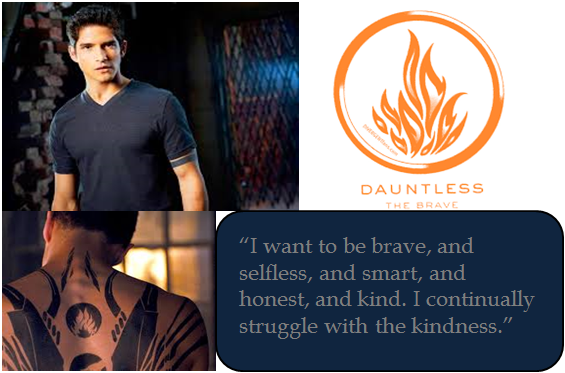
2. Tyler Posey as Tobias “Four” Eaton
At this juncture I would like to point out that I do think Theo James did a decent job with this role. But the fact remains that he’s not biracial. Tyler Posey, on the other hand, is. (His father is white and his mother is, I believe, Mexican-American.) Wow. Look at that. An actual biracial actor to play an actual biracial character. Look at that, Hollywood. It’s not that hard.


3. Lucy Liu as Jeanine Matthews
Confession time, here’s what I got: I have always imagined Jeanine Matthews, the villain, as East Asian, ever since I first read the books. The movies cast Kate Winslet, who plays the part pretty well, but is also blonde and white. I left the first movie a little annoyed by this (but not too annoyed, because I’m still not sure how Jeanine was described in the books). Most of this post was conceived after I saw Insurgent, but Lucy Liu has always been and will always be my top pick to play Jeanine Matthews.

4. Constance Wu as Natalie Prior
Natalie Prior is Tris’s mother, and she’s not a terribly important character, though she does get things done in the story, unlike some fictional mothers I could name. She’s played by Ashley Judd in the actual movie—but if Chloe Bennet were to play Tris, it would logically follow that one of her parents should be Chinese. I figured I’d keep her father (played by Tony Goldwyn) white and cast Constance Wu as her mother.

5. Kenny Leu as Caleb Prior
This is related to the above point. Caleb is Tris’s brother, so it follows that he would also be Chinese like her and their mother. That’s pretty much all I have to say here.


6. Esai Morales as Marcus Eaton
Marcus is Four’s father. When I originally thought up this alternate cast, I only included Four and Marcus (Four’s mother isn’t in the first movie)—so I figured, if I was going to cast a Latino actor to play Four, I should cast a Latino actor to play his father, too. Then, of course, Insurgent came out and I got involved in the whole mess surrounding the casting of Four and his mom. That led me to…


7. Rosario Dawson as Evelyn Eaton
After seeing Insurgent and reading up on the miscasting of Evelyn, Four’s mother, I just wanted to see a woman of color as that character. So, without thinking about it much, I added Rosario Dawson to my happy fictional alternate cast. It wasn’t until later that I realized why this wouldn’t work—namely, because Four is supposed to be half white, and neither Esai Morales nor Rosario Dawson are white. However, the movies cast non-biracial, but ambiguous-looking Theo James, and then made both of his parents white, so hopefully you’ll forgive me for casting actually biracial Tyler Posey to play Four, then making his parents non-white. (Morales is Puerto Rican-American and Dawson is, interestingly, also biracial, being black and Latina.) Were I to somehow do an actual reboot of the Divergent series, I’d probably do this differently, but for a fun thought-experiment blog post I’m not going to put that much effort into it.

So there you have it.

***

Ultimately, the Divergent series is about two teenagers trying to find their way in a world where people are divided into rigid, divided groups by a self-imposed system. It’s about young people rising up against a world telling them, You can only be one thing. I think that’s a story a lot of biracial/mixed kids can relate to, and I think it’s a shame we’re not allowed to see ourselves play out that adventure on the big screen. Divergent is a story so heavily centered on the theme of identity, a story that says, You can be more than one. You can have multiple facets of identity. Trying to pigeonhole people is reductive and doesn’t work.


Shouldn’t biracial kids be able to see themselves in that message, too?

Wednesday, March 23, 2016

Ant-Man

*Warning: Spoilers are contained in the following post.*

Confession time: I did not think I was going to enjoy Ant-Man.

When I first found out that Marvel was doing an Ant-Man movie, I was pretty excited. Thanks to Avengers: Earth's Mightiest Heroes, I knew who Ant-Man was and I was happy to see him getting a movie.

I got a little less excited when I learned that the movie would actually primarily be about Scott Lang, the second Ant-Man, rather than Hank Pym, the first. But hey, Hank was still in the movie, so I could live with it.

Then I found out that Marvel was not only making it all about Scott, but entirely removing the character of Janet Van Dyne, aka the Wasp. This was the final straw.

To those who don't know why this is a big deal, Janet Van Dyne was a founding member of the Avengers. In fact, Janet Van Dyne named the Avengers. (In more than one continuity!) Janet Van Dyne is the whole reason Hank Pym became a superhero in the first place. And aside from all that, Janet Van Dyne is a really fun character; she's a superhero, and a dang good one, but she's also fun, and humorous, and she's a fashion designer in her free time. (She's also Chinese-American in the Ultimates continuity, which means that Marvel had a wonderful opportunity to include a woman of color in their movie series, and they waved at it as it passed by.)

So yes, I was not happy about Marvel's decision, and as the Ant-Man movie looked pretty boring and generic anyway, I resolved not to watch it.

However, let me tell you from experience: when you are sitting on a plane at four o'clock a.m., having gotten two hours of fitful sleep before giving up on it entirely, none of your carefully thought out reasons for anything will make sense to you. This is how I got roped into finally watching Ant-Man. And...

I actually enjoyed it a lot more than I thought I would.

Let's start with that.

***

So, as it turns out, Ant-Man is actually pretty well-written. It's not as good as Iron Man, which is sort of my benchmark for good writing in the MCU, but it's definitely a lot better than Age of Ultron, which is my benchmark for bad writing in the MCU, because seriously, it was terrible. Ant-Man... well, it had its flaws, but overall it was pretty good. The pacing worked, it had a decent character arc for Scott, and the characters, and their relationships, were all pretty well built up. (With a few notable exceptions, which I'll talk about later.) 

Speaking of the characters, they were... good enough, I suppose. I will always be vaguely bitter about needlessly white movie casts, but as far as acting and characterization went, they were good. That's the interesting thing, I guess: none of the characters in this movie were particularly original or groundbreaking, but they were able avoid being cliché through a combination of good writing and good acting. I thought Evangeline Lilly as Hope Pym and Michael Peña as Luis in particular did a lot with the roles they were given. 

In fact, now that I bring it up, I think the same is true of the plot. Nothing about this movie's plot was particularly original; I think it's safe to say I've seen pretty much every element of this movie somewhere else. But the movie overall manages to avoid seeming generic, which is something I honestly didn't think it would be able to do. 

So overall? I liked how this movie was done. It exceeded my expectations, and I can honestly say I enjoyed it. 

However. 

That having been said, while I liked this movie, there was also a lot I didn't like. And if you think I'm not going to nitpick the heck out of this movie, just because it exceeded my expectations, well. You've got another thing coming, buddy. 

So here we go.

***

To start with, I am still very put out about how Marvel decided to treat Janet Van Dyne in this movie. 

Rather than be included in the movie at all, Janet is killed off to further the story of Hank Pym and his daughter Hope. Her full name isn't even stated anywhere in the movie, and she only appears in one (short) scene, where we don't even see her face. This was annoying enough for me, but it didn't end there. You see, in the movie, Hope Pym--Hank and Janet's daugher--is established and blatantly stated to be, hands down, the most qualified person to steal the volatile technology in question and save the world. However, her father (Hank) is unwilling to put her in danger, so he pulls a random thief guy (Scott) off the street and decides to have her train him to do the heist, so if someone does get hurt, hey, it'll just be that random guy we met a couple days ago. 

(I'll talk more about that a little later.)

This plot decision really, really irks me, because on the surface, yeah! It's a good setup! It works, and the writing supports it! And it leads to an interesting dynamic between the characters! But on a meta-narrative level, it doesn't work, because here we have the only female character in the movie, who is also the most qualified to be the hero. You know what that means? It means that Hope Pym should have been the title character of this movie. It means that the only reason she isn't is because Marvel wanted to make another movie about a mediocre white guy who gets superpowers. It means that this movie has double the sidelining of female characters, and that makes me angry. The movie even acknowledges this, because the mid-credits scene is of Hank finally accepting that his daughter is ready to be a hero and admitting that he's got a prototype Wasp suit ready to be finished! There was literally no reason Marvel couldn't have named this movie The Wasp!

(And as a side note on female characters--and this is more of a nitpick, but still a very annoying one--all of the ants in this movie are female and should have been referred to as such. Sorry, I don't make the rules. They're all girls. Especially Antony. You know why Antony has wings? Because she's a queen. Queens are literally the most female ants ever, and the only ones that have wings. Antony should've been named Antonia. No, I will not get over this.)

My other big problem with this movie is the villain, Darren Cross, aka Yellowjacket. Without getting into how they totally changed around the Yellowjacket suit origin, let me just say I was unsatisfied with how Darren Cross was presented. He's clearly written as having some undefined mental illness, but this is only used to make him seem ~stranger~ and ~scarier~ than the heroes and that irks me, because the MCU has yet to really do anything as far as disabled superheroes (except for Bucky. I guess.) so it's really kinda upsetting that they're playing into the Insane Villain cliché when they didn't have to. 

There were also a couple of jokes that left a bad taste in my mouth, largely because there was no reason to include them in the movie. Okay, so you're gonna make a deportation joke, when Latinos are still fighting stereotypes and blatant hate speech from presidential candidates in the year 2016? Okay. I guess. You're going to write in a throwaway line/joke about "g*psy magic" literally right after Joss Whedon casts a couple of white actors to play canonically Romani characters? Okay. You do you. I guess. 
(For those who don't know, "g*psy" is a slur that's unfortunately still commonly used to refer to Romani people.)
I just... there was literally no reason to put this stuff in the movie. Just because you can, doesn't mean you should, Marvel. 

So... while it's well-written, Ant-Man definitely isn't my favorite Marvel movie to date. Actually I'm kinda disappointed, because it's pretty good. The story is good, the characters are well-written, and there's actually some interesting subtext and considerations in there, so it's a shame that there's also stuff like sidelined female characters and a shoehorned romance. (I almost forgot about that. There is a shoehorned romance in this movie. I hate clumsily shoved in romances already, but this one in particular bugs me a lot, because Scott and Hope actually had a really well-built up and well-written friendship, and the fact that the writers felt the need to shove in a "Oh by the way we're together" scene at the end is disappointing.)

Speaking of that, it's time for a section of the review that I don't normally do. 

***

Here I'm going to (hopefully briefly) talk about some nuances. (This is a tribute to how good the characterization actually is in this movie.)

See, in the movie, Hank Pym, played by Michael Douglas, acts as a Wise Old Mentor character to Scott. He pulls him out of his kinda terrible life--hey, that's another thing. I've never seen a Marvel movie, or hardly any movie, really, that addresses how hard it can be to get a job when you've got a felony on your rap sheet. So, good job with that, at least, Marvel. 

Anyway. Hank Pym is the Wise Old Mentor. He's kinda there to guide Scott, teach Scott, and provide something of a cautionary tale about distancing yourself from your daughter to Scott. However, with the way he's written, there are parts of the movie were he comes off as really freaking shady. 

Like, I'm not even sure if this is what the writers were aiming for, which is what makes it so weird. But if you think about it, it's true. Hank's stated motivation for hiring (hiring? did he offer to pay him?) Scott is that he knows the heist might go down in flames, and he doesn't want his daughter to get hurt if that's the case. However, Hank also knows that Scott also has a daughter who he very much loves, and who loves him. And he knows that Scott, while a criminal, really is trying to turn his life around. (And he knows all this because he's been stalking Scott in some way shape or form, but Hank is rich, so it's not called that.)

So to review, Hank hires a guy who's just trying to pay child support and keep in touch with his daughter, manipulates that guy's attachment to his daughter to convince him to break the law again, all the while knowing full well that if everything doesn't go off without a hitch, this man probably won't see his daughter ever again, one way or the other. 

Yeah. If Hank Pym weren't a Good Guy, he'd definitely be a villain. In fact, why wasn't he the villain? I mean, why use the outdated, overdone Insane Villain cliché when this masterpiece of manipulation was sitting right here in the script?

I guess this is the kind of thing that makes me really upset about the mediocrities in this movie. It's easy to dismiss a movie that's just straight-up all-around terrible. It's a lot more frustrating when the movie has some genuinely good writing and interesting characters, but also has just enough White Male Ridiculousness to be aggravating. And, really, that's exactly what Ant-Man is: a thoroughly mixed bag. It's... probably one of the MCU's better movies. It's definitely better than Avengers: Age of Ultron and it's not as weird as Thor: The Dark World. It's fun. It's light. It's also kinda annoying, because if it had tried--if the writers had tried just a little harder, reworked just a few more things--it could've been really fun and really enjoyable. 

So that's Ant-Man. Better than I expected, but still annoying.

Sunday, February 14, 2016

The Comparison - Part 4

*Warning: Spoilers. Probably nothing that I haven't yet spoiled in the rest of this series, but you never know.*

Well, here we are, in the final installment of The Comparison--where I finally get around to the actual comparing of the two things I set out to compare. I've talked about Treasure Island (in two separate installments, no less!) and about its less-well-known adaptation, Treasure Planet. I've given an overview of opinion on both pieces of media, and now I'm going to compare and contrast them. As with both of the preceding reviews, this will be divided up into Plot, Characters, and Setting. So here we go with the thrilling conclusion...

***

First up: Plot.

As I mentioned in the last post, Treasure Planet is a movie, and not a particularly long one, so it didn't have the space to really stretch the story out the way the book did. This is actually a common thing; most book-to-movie adaptations have to cut some details for the sake of time. (Unless you're Peter Jackson, in which case you add details in order to take up more time. I'm still bitter.) Generally the question isn't whether the adaptation cut anything, but what they cut and how well they did it. 

In this case? I think Treasure Planet did a good job of condensing the plot. 

For one thing, they cut out the overly-long beginning, which I was really glad for. In the movie, Billy Bones shows up, he gives Jim the map (actually gives it to him!), mutters a vague warning about "the cyborg", and dies. Bam, we have kickstarted the plot.

This continues throughout the movie: everything that happens happens for a reason, to advance the plot somehow. Either it contributes to what's going on, or it gets cut. And it works.

Probably the biggest difference of all from book to movie is that the movie added an emotional subplot/arc that was not there in the book. This actually tied in well, I think, with the direction the adaptation was going. See, if you'll remember, back in my first Treasure Island post I talked about how Long John Silver's betrayal doesn't seem to have a lot of emotional effect on the characters. I also mentioned how the author didn't seem sure of how he was trying to portray Silver/build up the betrayal. Of course, both of these things were done fairly well, and I think in the context of the longer book they worked out. However, these creative decisions wouldn't have worked for a simplified, faster-paced version of the story, and I think the screenwriters knew this. Thus, I really like how it worked out in Treasure Planet.

You see, in the movie, the first mention of Silver we hear is Billy Bones telling Jim to "beware the cyborg" just before he croaks. Shortly afterward, we see a mysterious cyborg-looking shadow lead a group of pirates in burning the Benbow Inn. Thus, when we first meet John Silver, he's already been established as a very shady, if not outright villainous, character. That makes it all the more touching/suspenseful to watch him and Jim form a father-son bond, and that, in turn, makes his subsequent betrayal all the more terrible.

As a side note, in the movie, I feel like Mr. Arrow's death was tied into the greater plot in a way that made more sense. In the book, as I've said, Arrow is a drunk loser who falls overboard during a rainstorm and nobody cares. In the movie, Mr. Arrow is an upstanding first mate--a good friend and confidant of the captain--who is killed by Scroop, who then makes it look like it was indirectly Jim's fault. This ties into Jim's arc and his relationship with Silver, but it also establishes just how far Scroop is willing to go as a villain, and it's a genuinely tragic moment, since Arrow was such a great guy.

And of course--spoiler warning here--the ending of the movie is vastly different from the book. Flint's trap is a big difference (that wasn't present in the book), as is the treasure being destroyed and the last-second escape from the treasure horde place.

Silver still gets away from the good guys and escapes justice in the book, though.

(There you go. I just told you the whole ending. Now you don't have to watch the movie.)

Next up: Characters.

The characters in Treasure Planet are mostly similar to those in the book. However, there are some differences here worth talking about, so here we go.

First up: Jim Hawkins. Jim Hawkins, in the movie, is older than his book counterpart. (He's fifteen in the movie, if I'm remembering correctly.) He's very smart, but he's also reckless and sullen, feeling he has no future worth considering.

The main difference with this character is probably his recklessness. As I said in my first Treasure Island post, I feel like Jim's impetuousness wasn't a very consistent character trait. This isn't the case in the movie; Jim is very reckless and while it sometime helps him or works out in his favor, other times it's purely self-destructive. It's also part of his character arc: over the course of the movie he learns to harness his impulsiveness and think through his actions more.

Next is Dr. Delbert Doppler, who as far as I can tell is a composite character, a cross between Squire Trelawney and Dr. Livesey from the book. He's got Trelawney's naivete about the workings of the world, but he's also got Livesey's intelligence and doctorate. (He's not a medical doctor in the movie. So that's different.) He occasionally functions as comic relief, but he's also a character in his own right. (He's also, in the movie, an alien that kinda looks like a dog. It's a little weird.)

I already talked about Captain Amelia, who's different enough from her book counterpart that she counts as her own character. I don't want to repeat myself, so all I'll say is: I really like Captain Amelia and I'm glad she's in the movie. She's a great character.

The other female character in the movie is Jim's mother, Sarah Hawkins, the sole proprietor of the Benbow Inn. Yes, that's right: the movie removed the character of Jim's father, and they did it for a few good reasons. A) Jim's dad doesn't do much in the book other than get sick and die in the beginning. B) Jim's abandonment issues concerning his father tie into his emotional arc and the relationship he has with Silver. C) It's just all around a more economical use of a character. In my opinion, anyway.

And then, of course, there's Silver, the villain.
Silver is... well, he's actually pretty similar to his book incarnation. He's smart, fast-talking, eloquent, ambitious, murderous, and he hides it all under an exterior that's kind, friendly, and respectful of authority. However, in the movie, his relationship with Jim is a lot more pronounced, and a lot more integral to the story. Also, as far as I can tell, he never knew Captain Flint personally in the movie.

And... I think that actually wraps it up for the Characters section. I'm running short on space here, so let's move along to Setting.

The settings... well, whether you're in the book or the movie, the settings are beautifully imagined and communicated to the audience. The scale is much larger in the movie (they're travelling between planets, through space), but that comes with the territory in a sci-fi film. Obviously the movie is inherently more visual, but if you've read the book you know that Robert Louis Stevenson held nothing back in his descriptions of his settings. (Especially the island itself.) So I actually think the book and movie are pretty similar in that respect. And I think it's somewhat indicative of the overall spirit of the adaptation: there are several changes in terms of aesthetic and scale, but the overarching plot and characters are pretty similar to those in the book.

***

So that's The Comparison! I have to say, I'm glad this series is over, but I haven't regretting writing it. (Remember, folks, this was originally all supposed to be one post.) Actually, I'm largely glad this is over so that I can get to posting about other things. I've got some good things in the works, including a book review and a particularly relevant history post. So stay tuned for that stuff... and feel free to come bug me over at my newly minted Facebook and Twitter pages! And as always, feel free to leave any thoughts, questions, or critiques in the comments section.

Until next time: adiós!

Wednesday, February 3, 2016

Treasure Planet - The Comparison, Part 3

*Warning: Spoilers. You guys know the drill by now.*

Aaaand we're back, with part three of the comparison! It's been kind of a crazy few days since I last posted, but the good news is that my library request came in, I watched it, and now I'm ready to review Disney's 2002 sci-fi adaptation of Treasure Island.

So here we go.

***

To start: Treasure Planet is one of Disney's early-2000's movies, and it isn't well known for a few reasons. For one thing, the premise is a little weird and doesn't appeal to everyone. (It's Treasure Island, but in a setting that's a cross between Pirates of the Caribbean and Star Wars. Like I said, weird, and that's coming from someone who really likes it.) Another reason is that it did terribly at the box office, meaning Disney didn't have much incentive to spend a lot on post-release merchandising or a sequel. 

All that said, it's a weird, mostly unknown, pretty underrated movie, but the writing is pretty solid and the visuals are gorgeous. 

First up for me to talk about is the writing, otherwise known as the plotTreasure Planet is a movie, and not one of those crazy three-hour movies, so the screenwriters naturally had to compress the story somewhat. And, in my opinion, they did it well; overall, the story is tight, with a logical, emotional character arc, and with plenty of action. It doesn't drag at all. (Remember when I was complaining about the beginning of the book being too long? Yeah.)

The story is still presented from Jim's point of view, with a few deviations. (And by deviations, I mean scenes that are used to establish the villain and maintain tension.) Also, everything that happens to move the plot happens for a reason; there's a nice tension between characters making choices and movements for themselves, and characters being forced to move because of something the villain(s) did. 

The movie also remedied the lack of tension in the latter third of the story. (Remember that? Where there was pretty much no chance that the pirates were going to win?) In the movie, it looks like the pirates might just win, right up until they trigger the trap that starts destroying the treasure. 

Also, everything in the plot moves faster from a physical standpoint, because space travel. 

Moving on: Characters!

Treasure Planet maintains most of the main characters from the book, with the caveat that most of them are aliens or robots (or both). This is because of the setting. It's a little strange at first. Whether you get into it or not as the movie goes on is up to you. This is where the movie deviates from the book a good deal; I'll reserve my thoughts on that for the next and final installment in this series. For now, since you've heard my thoughts on most of the characters, I'll just talk about the original(ish) characters that the movie added/played around with. 

The most prominent original-ish character is Captain Amelia, who replaces Captain Smollett in the story. (Also, as a note, the ship's name in the movie is the Legacy, rather than the Hispaniola. Make of that what you will.) Amelia basically serves the same purpose as Smollett: she doesn't like the crew, she's an iron-willed leader who helps fight the mutineers, she gets wounded and sorta taken out of commission during one of the fights. The main things that make her distinct and original are a) she's an alien, b) she's involved in a romance (of which there was none in the book), and c) she's the only main female character in the story (this is related to point b). This is refreshing because in the book, the only female character was Jim's mother (who is also in the movie, and is a bit more fleshed out). I guess you could say that Amelia is proof that you can have female characters in your story without compromising the way you were planning to characterize them.

The other character that was pretty much just made up for the purposes of the movie is Scroop, a.k.a. the really unsympathetic guy you're supposed to hate because he's a terrible person. (Most movies have one of these. On one hand, I know it's often a necessary storytelling technique, but on the other hand, it just bugs me so much. No one in real life is that one-dimensional!)
Anyway, Scroop is a spider-like alien who, as far as I can tell, is a composite of several one-off, villainous pirates from the book. He largely exists to create extra conflict and to do the stuff that would make our sympathetic villain look bad. (Like killing people.) He also ends up dying, in a manner suspiciously similar to the way Israel Hands from the book died, which leads me to believe that that's his closest counterpart. But again, it's debatable, since Scroop is probably a combination of several. 

So that covers the semi-original movie characters. 

Finally, we have Setting, and this is the part where I'm really going to rave about the movie. (So if you really didn't like it or something, you can skip this part. I guess.)

Treasure Planet was made as Disney was beginning to experiment with 3-D animation, and it's revolutionary in its own way, in that it's one of the first movies where 2-D and 3-D animation were blended. You can still tell where the 3-D animation is, but for the most part the two styles mesh very well and don't distract from the story. And the designs--the designs for everything, but especially for sets and backgrounds, are breathtaking and gorgeously animated. From the busy spaceport of Montressor to the Legacy itself to the titular planet, everything is wonderfully designed and animated. What's most impressive to me is the design for Long John Silver, who's a cyborg in the movie. He's mostly animated in 2-D, but his cyborg parts--a leg, an eye, and an arm--are all 3-D, and they're seamlessly animated. Seriously, this is one of those movies that you could watch on mute just to look at how beautifully it was done. 

Additionally, the scope of the story is expanded in the movie, which is a normal thing in sci-fi. Rather than various geographic locations, the different settings are planets. I think this expansion was particularly well-handled in the case of Treasure Planet itself. The fact that it's an entire planet rather than--I don't know, a moon, or something--factors nicely into the plot.

As a final point, event though the movie has a sci-fi setting, it still has many of the trappings of the traditional 18th Century Piracy genre. The Legacy looks and acts like an 18th Century sailing ship, with modifications for space travel. (A warning: almost nothing in this movie is scientifically accurate.) It even has barnacles, cannons, and longboats. The stationary settings, like the Benbow Inn and Montressor spaceport, also look a lot like 1700's locales, but they're populated with aliens and have just enough futuristic tech to support the sci-fi image.

So that's the setting. In my opinion, Treasure Planet is high on the list of Disney's beautifully designed films, and the way both kinds of animation were used is truly impressive.

***

That more or less concludes my review of Treasure Planet. You'll notice that it's shorter than my review of Treasure Island. This is because I'm saving a lot of my opinions for the straight-up comparison of the two, which will be in the next post. In the meantime, I highly recommend that you at least try watching Treasure Planet. (It's unfortunately no longer available to stream on Netflix, but it is available in DVD format. Also try your local library.) If you like Star Wars, there's a good chance you'll like it. And if you don't, you might also try muting it and enjoying the animation and design. 

So that's Treasure Planet. Tune in next time for the thrilling...ish... conclusion of the ridiculous and long comparison series. Adiós!

(To Be Concluded...)