Showing posts with label History. Show all posts

Saturday, December 31, 2016

2016 Recommended Books List

2016 has been a pretty full year for me, and I suspect for everyone else, too. We had an election this year, and that was certainly a wild ride from start to finish. A lot happened in the world. We lost some pretty amazing people. A lot happened in my life, too, although I'd hope those events were more positive than what happened in the world and the U.S. at large.

I read quite a few books this year, in between school and writing and spending time with family. A lot of those books were amazing, the type of books that take hold of something in your soul. Looking back at the list, it's an odd combination of non-fiction and sci-fi/fantasy, with one lone exception. These are all books that deeply appealed to me in some way, whether that was the premise or the characters or the overall theme of the book. I would highly recommend them all.

***

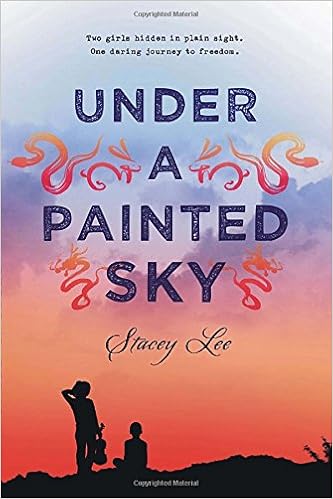
1. Under a Painted Sky by Stacey Lee
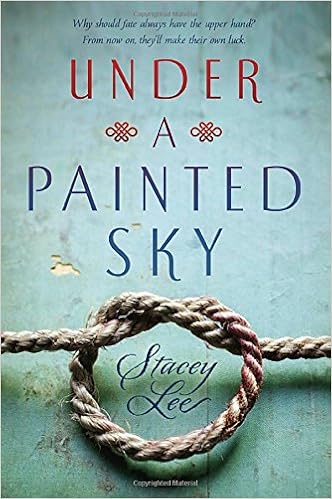
Summary: Missouri, 1849: Samantha dreams of moving back to New York to be a professional musician--not an easy thing if you're a girl, and harder still if you're Chinese. But a tragic accident dashes any hopes of fulfilling her dream, and instead, leaves her fearing for her life.
With the help of a runaway slave named Annamae, Samantha flees town for the unknown frontier. But life on the Oregon Trail is unsafe for two girls, so they disguise themselves as Sammy and Andy, two boys headed for the California gold rush.

Sammy and Andy forge a powerful bond as they each search for a link to their past, and struggle to avoid any unwanted attention. But when they cross paths with a band of cowboys, the light-hearted troupe turn out to be unexpected allies. With the law closing in on them and new setbacks coming each day, the girls quickly learn that there are not many places to hide on the open trail.

I read this book way back in February, and I absolutely adored it. In fact, it's pretty much the book that got me started doing book reviews on this blog. Once I read this book, I felt the need to share it with as many people as I possibly could. I've written a much longer review already, but to sum it up: this is a well-written book with amazing characters and an incredibly nuanced view of the Old West. I highly, highly recommend it. 


2. Starflight by Melissa Landers
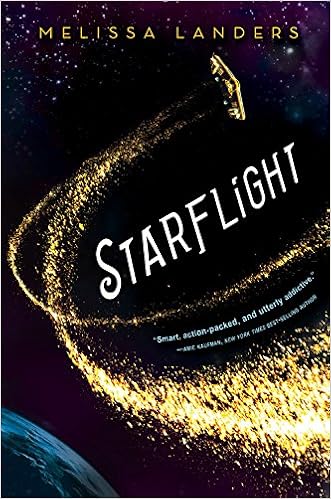
Summary: Solara Brooks needs a fresh start, someplace where nobody cares about the engine grease beneath her fingernails or the felony tattoos across her knuckles. The outer realm may be lawless, but it's not like the law has ever been on her side. Still, off-world travel doesn't come cheap; Solara is left with no choice but to indenture herself in exchange for passage to the outer realm. She just wishes it could have been to anyone besides Doran Spaulding, the rich, pretty-boy quarterback who made her life miserable in school.

The tables suddenly turn when Doran is framed for conspiracy on Earth, and Solara cons him into playing the role of her servant on board the Banshee, a ship manned by an eccentric crew with their own secrets. Given the price on both Doran and Solara's heads, it may just be the safest place in the universe. But when the Banshee's dangerous enemies catch up with them, Solara and Doran must come together to protect the ship that has become their home-and the eccentric crew that feels like family.

I read this book in about half a day. It's a fun, fast-moving little sci-fi story with fun characters and a plot that features plenty of twists and turns. It's not the best book I've ever read; and it's not deep and thought-provoking like Under a Painted Sky. But it's a book I greatly enjoyed, and it's the type of fun, inoffensive sci-fi fluff I like to read when my brain needs a break and I don't want to have to critique something too hard.


3. Women Heroes of World War II by Kathryn J. Atwood
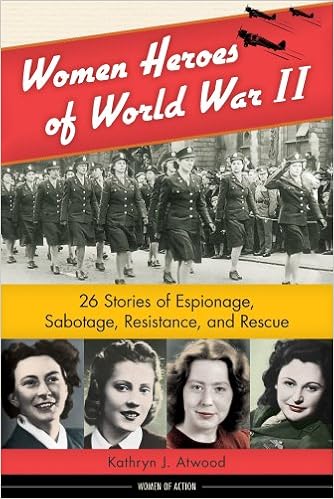
Summary: Noor Inayat Khan was the first female radio operator sent into occupied France and transferred crucial messages. Johtje Vos, a Dutch housewife, hid Jews in her home and repeatedly outsmarted the Gestapo. Law student Hannie Schaft became involved in the most dangerous resistance work--sabotage, weapons transference, and assassinations. In these pages, young readers will meet these and many other similarly courageous women and girls who risked their lives to help defeat the Nazis.
Twenty-six engaging and suspense-filled stories unfold from across Germany, Poland, the Netherlands, France, Belgium, Denmark, Great Britain, and the United States, providing an inspiring reminder of women and girls’ refusal to sit on the sidelines around the world and throughout history.

I first encountered this book while volunteering at my local library. It seemed like the type of book I would like, so I checked it out and started reading. And just as I'd suspected, I loved it. This book tells the story of a variety of female heroes during World War II, most of whom are rarely taught about elsewhere. It doesn't restrict itself to any one type of hero, either. Included are women who fought the Nazis nonviolently, like Sophie Scholl and Johtie Vos, and much more literal fighters like Hannie Schaft. Women of color are included in the stories of Noor Inayat Khan and Josephine Baker. The faith and religon that inspired many of these women, such as Corrie ten Boom, isn't overlooked. Each story is concise yet important. This book really is an important reminder of women who were not afraid to do what they knew was right, even in the face of death.


4. Failures of the Presidents by Thomas J. Craughwell and M. William Phelps
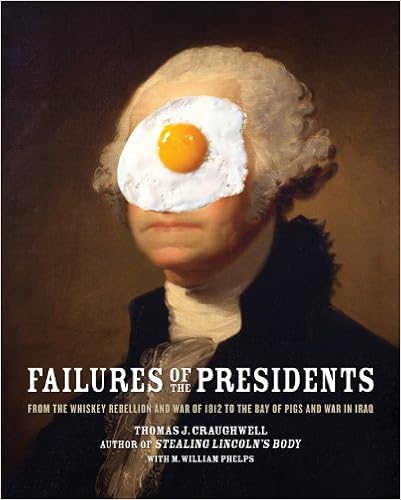
Summary: In an effort to put an end to Britain and France’s policy of seizing American ships and sailors, Thomas Jefferson calls for an embargo. The result: 30,000 soldiers out of work, mercantile families bankrupted, and a nationwide economic depression.

In an effort to install a capitalist government in the Middle East, stabilize the region, and protect America from a possible Iraqi terrorist assault using weapons of mass destruction, George W. Bush orders the invasion of Iraq. The result: More than 4,000 American soldiers and personnel dead; estimated hundreds of thousands of Iraqi civilians dead; hundreds of billions of dollars spent; the torture of prisoners in the Abu Ghraib prison and the failure to find weapons of mass destruction leave American global credibility in tatters.

What were they thinking?

One of my favorite genres of history, so to speak, is the "American history they didn't teach you in school" genre. This book appeals very heavily to that interest of mine, as it not only explores little-known anecdotes from history, but calls attention to the flaws of most U.S. presidents. It's a fairly unbiased book that provides cultural and historical context for the presidents' various decisions, without absolving them of the consequences. This is the kind of history I very much appreciate.


5. On Basilisk Station by David Weber
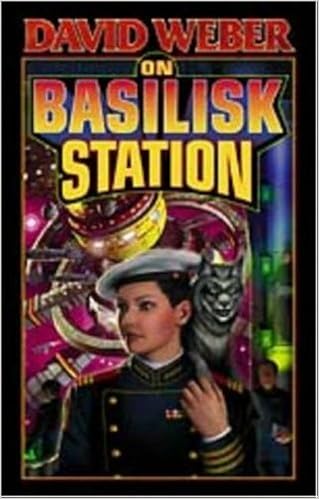
Summary: Having made him look a fool, she's been exiled to Basilisk Station in disgrace and set up for ruin by a superior who hates her. Her demoralized crew blames her for their ship's humiliating posting to an out-of-the-way picket station. The aborigines of the system's only habitable planet are smoking homicide-inducing hallucinogens. Parliament isn't sure it wants to keep the place; the major local industry is smuggling; the merchant cartels want her head; the star-conquering, so-called "Republic" of Haven is Up To Something; and Honor Harrington has a single, over-age light cruiser with an armament that doesn't work to police the entire star system. 

But the people out to get her have made one mistake. They've made her mad. 

This is another book I've already done a full review for, back when I read a bunch of SF novels over the summer. I enjoyed it pretty thoroughly, since it takes the story of the "misunderstood military genius" and gives it to a female protagonist. It's well-written and the story moves just fast enough. I've heard that this series (the Honor Harrington series) is based off of the Horatio Hornblower books, and it does seem that way, but the books are different enough, in genre and in writing, that they don't come off as too similar. I look forward to reading the next book, whenever I can find it. 


6. Steelheart by Brandon Sanderson

Summary: How far would you go for revenge if someone killed your father? If someone destroyed your city? If everything you ever loved was taken from you?

David Charleston will go to any lengths to stop Steelheart. But to exact revenge in Steelheart’s world, David will need the Reckoners—a shadowy group of rebels bent on maintaining justice. 

And it turns out that the Reckoners might just need David too.

This is yet another book that I've previously reviewed on this blog. Again, see that post for my complete thoughts. To make a long(ish) review short, well... This is a book with a very unique perspective on superheroes. It turns genre conventions upside down and tells a heartfelt, enthralling story, and the whole thing is very well-written. As a side note, the sequels are just as good. I'd recommend the whole Reckoners trilogy, which stems from this book; but even as a standalone, Steelheart is awesome, and comes highly recommended by me.


7. War of the Worlds by H.G. Wells
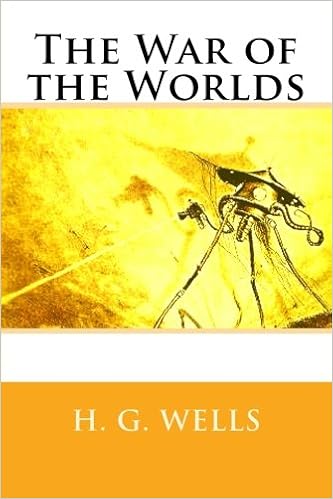
Summary: After Martians invade Earth—specifically, England—a philosophically-inclined writer is set on a journey across the ravaged English countryside as he attempts to find his wife and, with luck, avoid death. 

This is this year's obligatory really old, yet surprisingly good novel (last year's was Jules Verne's Around the World in Eighty Days). First published in 1898, War of the Worlds is thought to be the first mainstream alien invasion story, and besides being groundbreaking science fiction, it also carries some scintillating social commentary. It isn't as exciting or fast-moving as modern sci-fi, but it still carries its fair share of action. The best part of the novel, though—at least in my opinion—is the atmosphere Wells creates with words alone. The scenarios presented in the novel, the hopelessness and fear, were mildly terrifying even to me. They're even sharper when you think of how nineteenth- and twentieth-century readers must have perceived the story. All of Wells's fiction was based on real science of his day, after all.

***

So there you have it: seven books I read this year and loved. I'd recommend all of them, especially if you're a fan of science fiction or history. Even if you're not, these are still, in my opinion, valuable books. If you've read any of these or end up reading them in the coming year, I'd love to discuss them. Until then, Feliz Navidad, Happy Holidays, and a Happy New Year

Tuesday, June 7, 2016

My Family Wouldn’t Have Existed In Any Other Century

I am biracial. I have never made any bones about this fact, because I’m proud of it. My father is a Puerto-Rican Latino and my mother is white, of Dutch and Czech descent. I’m biracial, and I’m happy about it. I wouldn’t have it any other way.

I also have an interest in history. This may be because my mother taught me to read pretty early on and homeschooled me from there. I grew up reading a lot, and a lot of the reading material provided to me was history or historical fiction. Not all of it was age-appropriate. But most of it appealed to me enough to foster an interest in stories of the historical persuasion.

I remember the first time I realized just how ahistorical my family is.

I was watching North and South with my mother and sister. For anyone who hasn’t read or seen North and South, it’s a romance set during the Industrial Revolution in England. There’s a plot point toward the middle of the story involving the main character’s brother, who fled to Spain to escape an unjust mutiny charge. The brother ends up marrying a Spanish woman.
           
So I’m watching this movie-mini-series with my mother and sister, right? And when this part comes up, my mom remarks, sort of off-handedly, “That’s the only way people from different countries really met back then. That’s how me and your dad would have met.”
           
I had never considered this before. For the first time I was confronted by the fact that in another century, my parents would likely never have met. I would not have been born to my parents in any other century, barring a few unlikely turns of events.

This was the first time I thought about this, but it would not be the last. My father has an interest in the origin of names. It turns out “Gonzalez” roughly translated means “son of a battle elf”, which is massively cool. It also turns out that it is completely legal to buy and ship an old-style forged sword. And it turns out that the family name and family legacy (and the cool sword that my family now owns) historically are passed down to the oldest son (my younger brother), not the oldest child (me).
           
It’s very cool and fun, if a tad bit frustrating, to have this family name and family sword and family legacy that gets passed down. But then again, historically, would my parents have had the opportunity to meet in Middle Ages Europe, where all this comes from? Would my siblings and I have existed in that time?
           
Fast forward. I’m out at a restaurant with my family, and we’re discussing media representation. My sister is saying that things are better than they ever were, that there are more women and people of color producing things now than there ever have been. I reply that yeah, things are better, but white people and white men especially still dominate the industry.
           
“Wow, I’m so glad you were born now and not in the 1920’s,” my mom says.
           
“Would I have been born in the 20’s? Would you guys have even met?” I gesture to my parents.
           
That’s the final word of that conversation.
           
This isn’t something that bothers me all the time. I read about history quite often and it’s fun and informative and I like doing it. I like reading about the early history of America, or the life and times of Shakespeare, or the many dynasties of ancient China. But whenever I begin to insert myself into those stories—whenever I think, Wow, what must have it been like to live then?—the knowledge is always present: I couldn’t have been there.
           
It’s fun to think about being alive during the American Revolution, but it’s not fun to know that I and my siblings would not have been safe or accepted then, assuming we were born at all. Incidentally, this has also affected my love of the time travel sub-genre. Yeah, I would love to travel back to 1885, except no I wouldn’t, because no matter how white-passing I am I know I would never feel safe. I would constantly be looking back over my shoulder because heck, do you know how long interracial marriages were illegal in the United States?

I love history. I know how important it is to study history, and more often than not I love doing it, because history contains a wealth of instructive, inspiring, hilarious, exciting and downright bizarre stories. But I don’t idealize or romanticize history. A great deal of history is sad and cruel and ugly. A lot of American history is off-putting and unwelcoming for women and people of color. I know you sometimes have to take the bad with the good, and I still see myself as an American despite all of this. But I refuse to look at history with rose-colored glasses. I don’t want to “take America back” or “make America great again” or any other variation of that sentiment, because nearly every other period of American history would have been unsafe, if not downright hostile, for my family. America has always been flawed. I want to keep moving forward, because an interracial family like mine couldn’t really have existed in any other century. I don’t want to go back to that! I want to learn as much as I can from history and, God willing, create a better world for my children and nieces and nephews.

Thursday, April 28, 2016

History Recap: 7 Historical Figures You've Probably Never Heard Of (Part 2)

[Part I of this post]

Last time on History Recaps, we talked about the hero of the Revolutionary War, the last monarch of Hawaii, and a scientist and a sniper both alive during World War II. Today we continue with a couple more people alive during World War II, and another scientist, this one involved in the space program.

Hopefully your interest is piqued by now, so on we go!

***

5. Josephine Baker (1906 - 1975)
Josephine Baker was an  African-American jazz dancer who accomplished a lot of almost-unbelievable stuff in her time. She was born into extreme poverty in St. Louis, and one of the few bright spots in her early life was dancing. When she was ten, she won a dancing contest put on by a travelling salesman, and this gave her purpose. As she became an adult, she was able to find steady work as a dancer, and eventually she attracted the attention of touring show producers who ran a show that was leaving for Paris. Josephine joined their show, excited to visit Paris and hoping both to see the world and to escape some of the racism she faced in the U.S.

In Paris, and jazz music and the Harlem Renaissance were rising in popularity, and since Josephine, a jazz dancer herself, seemed to embody everything beautiful about black people, she quickly became one of the most famous, popular people in Paris. She was the most photographed woman of 1926, and inspired such artists as Ernest Hemingway and Pablo Picasso. She starred in a film called Zou-Zou, making her the first black woman to have a leading role in a film. Highly paid for her dancing and singing performances, some estimate that she was the richest black woman in the world at the time.

However, not everyone appreciated Josephine. During many of her tours in Germany and Austria she encountered virulent racism, and quickly, rightfully, came to associate that racism with the Nazi party. As Nazi influence began to spread across Europe, Josephine became determined to fight it in anyway she could.

So she became a spy.

No one was going to suspect the lively, vivacious dancer and entertainer of being a spy for the French Resistance. As she toured Italy, Josephine attended many functions that along with high-ranking members of Mussolini's government and army. Here she was able to gather information and pass it along to the Resistance. She also did work in the French colonies in North Africa.

After the war, Josephine went on to campaign against segregation in the U.S., refusing to perform for segregated audiences. She faced some financial troubles as she got older, but continued to captivate audiences young and old.


6. Hannie Schaft (1920 - 1945)
Jannetje Johanna Schaft, known as Hannie, was a university student in Holland when it was invaded and taken over by Germany. One of the terms of the occupation was that all Dutch university students had to sign a declaration of allegiance to the German government. Hannie was close friends with Philine Polak and Sonja Frenk, both of them Jewish, and this was one of Hannie's main reasons for refusing to sign the declaration. Unable to continue college, she went to live with her parents, and eventually joined the Dutch communist Resistance.

Resistance groups all over Europe were eager to hire women as couriers and messengers, since women traveling around the country were a lot less likely to be stopped and/or forcibly conscripted than men. However, Hannie wasn't willing to stop at merely being a courier; she wanted to fight. So, the Resistance trained her and two other young women as assassins.

Hannie soon gained a reputation with both sides. The Germans dubbed her "the girl with the red hair" after she was seen but not identified in the field. After this, Hannie died her hair dark and continued operating.

Many Resistance couriers throughout World War II operated for years without being caught and lived to tell the tale. Hannie was not one of them. She was caught at a military checkpoint by the Germans, and once they had identified her as the red-haired assassin, there was no opportunity for escape. Hannie was brought to the Bloemendaal sand dunes in Holland and executed at short range. The Nazis buried her body in the sand; after the war, four hundred and twenty-two bodies were found there. All of them were male except for Hannie.

Hannie was posthumously honored by Princess Juliana of the Netherlands after her body was recovered. However, due to her ties to the Dutch Communist Party and the reputation communism gained after World War II, Hannie's popularity declined for a while. She has been recognized in several different ways in Holland today, but she remains an obscure historical figure.


7. Margaret Hamilton (1936 - ?)
Margaret Hamilton, née Heafield, is a computer scientist who worked on, among many other things, the Apollo space mission. She received her BA from Earlham College, majoring in math and minoring in philosophy. After graduation she postponed her PhD, first to support her husband while he worked on his undergraduate degree, then to take an interim position MIT to help develop weather-predicting software. At this point, neither computer science nor software engineering were named fields; programmers learned on the job, through hands-on training. From 1961 to 1963 Margaret worked on the SAGE project (the first computer built to search for unfriendly aircraft), and also worked with the Air Force Cambridge Research Laboratories.

It was through her work on the SAGE project that Margaret qualified for work on the Apollo 11 mission. She joined the Charles Stark Draper Laboratory at MIT, joined the work on the Apollo space project. Hamilton and her team pioneered the software the project needed to navigate and land on the moon. Hamilton, and her team, actually saved the moon landing by designing and implementing an "asynchronous executive", a program that enabled the computer to drop low-priority tasks if necessary to preserve computing power. Thus, when the rendezvous radar, a comparatively unimportant part of the project, started overloading the computer with unimportant pieces, of data, the computer was able to deal with the radar and continue functioning. It is now agreed that without this program, and the foresight and skill that went into it, the moon landing might not have happened.

Margaret Hamilton also co-founded Higher Order Software and founded Hamilton Technologies, Inc., and was CEO of both companies. In 1986 she received the Augusta Ada Lovelace Award from the Association for Women in Computing, and in 2003 she was given the NASA Exceptional Space Act Award for her contributions. She popularized the term "software engineering", and the programs that she pioneered in that field are still in use today.

***
Sources/Further Reading

Liberty's Kids - Okay, technically this isn't a book, it's a TV series, but it's still one of the better summaries of the American Revolution I've seen. It concisely and accurately covers the entire Revolution, and covers such obscure historical figures as Phyllis Wheatley, Deborah Sampson, Moses Michael Hayes, and yes, James Armistead. 

James Armistead Lafayette at Biography.com.

Kaiulani: The People's Princess by Ellen Emerson White - This book, a fictional diary of the real Princess Kaiulani, was my first exposure to the history of Hawaii and the story of Queen Liliuokalani. It was also kind of my only exposure, because we still don't talk about this hardly at all here in the U.S. But I digress. 

Liliuokalani at the Encyclopedia Britannica website. 

Lise Meitner at the Nobel Prize database... 


"Meet the world's deadliest female sniper who terrorized Hitler's Nazi army." - Great article that sums up Lyudmila Pavlichenko's life and exploits. It's at Business Insider for some weird reason. 

Women Heroes of World War II by Kathryn J. Atwood - This is a great book that tells the stories of twenty-six women who did incredibly heroic and courageous things during World War II. It was my primary source for Josephine Baker and Hannie Schaft, but it also talks about twenty-four other women, including Sophie Scholl, Noor Inayat Khan, and Corrie Ten Boom. I would definitely recommend giving this book a read. 

"Meet Margaret Hamilton, the bada** '60s programmer who saved the moon landing." - Vox.com article telling the story of how Margaret Hamilton saved the moon landing. 

Margaret Hamilton's About Page at the NASA Office of Logistice Design webpage.

***

Thanks for reading, and I hope you enjoyed this second post more than I enjoyed writing it! If you have any comments, questions, critiques, or if you just want to chat about cool historical people, feel free to leave a comment. Until next time!

Monday, March 28, 2016

History Recap: 7 Historical Figures You've Probably Never Heard Of (Part 1)

I've really been on a history kick lately, it seems. But hey, what can I say? I'm learning things, you guys are learning things, and we're both (hopefully) having fun, so on we go with the history recaps.

Today I thought I'd (mostly) take a break from the American Revolution. So we'll be spanning several different eras and events with one of my favorite topics: Historical People You've Probably Never Heard About (For One Reason Or Another). Today we'll be going over seven; not an exhaustive list by any means, but a good starting place. As a coincidental bonus, none of the people on this list are white men.

And so, without further ado, here we go! (With Part One. This got longer than I expected it to, so this is just Part One. Part Two will contain the rest of the list and some additional sources you can look into.)

***

1. James Armistead Lafayette (1760 - 1830)
We all know the stories. America never would have won the Revolutionary War without two things: French involvement and the superior strategy of America's leaders. These two things culminated at the 1781 Battle of Yorktown, where American and French forces combined to pen the British in on all sides at Chesapeake Bay. But what most people don't know is that this victory was facilitated, in part, by a black spy named James Armistead.

James Armistead was a slave when, in 1781, he volunteered to join the American army. He ended up serving as a spy under the Marquis de Lafayette. Since the British army had successfully one-upped the Americans by offering freedom to any slave who joined their army, it was easy for James to pose as a runaway slave and "join" the British army under Benedict Arnold--yes, that Benedict Arnold. And apparently, James was such a good spy that Benedict Arnold, a longtime spy himself, trusted him completely.

In the spring of 1781, Arnold went north and James Armistead repeated his ruse, this time with Cornwallis. Cornwallis also fell for it hook, line, and sinker, and James was free to travel back and forth between the British and American camps, carrying information to the Americans and feeding misinformation to the British. Much of the information he carried to other American spies was instrumental to the American success at Yorktown.

After the war, though there were some legal provisions for freeing slaves who had served in the army, James was denied this because ~technically~ he'd only served as a spy, not a soldier. (Yeah, I have no idea how they told him that with a straight face, either.) Fortunately, James was able to petition the Virginia Assembly for freedom in 1786. With the help of a testimonial Lafayette wrote for him in 1784, he was manumitted. At that point, he changed his name to James Armistead Lafayette in honor of his commanding officer.
(In 1824, while Lafayette was touring America, he and James ran into each other again and had a joyful reunion. At this time, Lafayette wrote another testimonial on his behalf.)

In conclusion, most people know about the decisive American victory at Yorktown, but most people don't know that if not for James Armistead Lafayette, we might never have won that battle.


2. Queen Liliuokalani (1838 - 1917)
Also known as Lydia Kamakaeha, Lydia Liliuokalani Paki, or Liliu Kamakaeha, Queen Liliuokalani was the last monarch of Hawaii before it was annexed by the United States. She was raised in a high-ranking family, receiving a modern education and spending time touring other countries in the Western world. In 1862, she was married to John Owen Dominis, an official in the Hawaiian government. In 1874, her brother, David Kalakaua, was chosen as king. After her second brother, the heir apparent, died in 1877, Liliuokalani was named heir presumptive. After Kalakaua died in 1891, Liliuokalani became the first female ruler of Hawaii.

Liliuokalani regretted the loss of power the crown had experienced under her brother, and did her best to recover some of that power. This move alienated the foreign businessmen who had set up shop in Hawaii, and they promptly tried to annul the queen's power. Eventually, the Missionary Party, led by Sanford Dole, basically led a takeover of Hawaii by requesting Liliuokalani's abdication and then setting up their own government, after declaring her deposed. Liliuokalani went along with it to avoid bloodshed, but submitted a request to President Cleveland to reinstate her. Cleveland granted her request and withdrew support for Dole, but Dole--determined to get his own way--rejected Cleveland's authority on the matter and set up a government independent of the U.S., the Republic of Hawaii. An 1895 insurrection against this government, in the queen's name, caused Liliuokalani to be placed under house arrest.

Liliuokalani fought bitterly against U.S. annexation, but it happened anyway in 1898. The former queen then wrote and published a book: Hawaii's Story by Hawaii's Queen. She also composed "Aloha Oe".

In conclusion, Liliuokalani was both the only female monarch of Hawaii and its last ruler. She fought for her country in her own way and though she was eventually defeated by the U.S., she never stopped loving her country. It's a shame that she is remembered by so few people.


3. Lise Meitner (1878 - 1968)
Lise Meitner was a Jewish, Austrian scientist who was instrumental in the discovery of nuclear fission and how particles behave under bombardment. Her story was--is--exceptional almost from the beginning. To begin with, women in Vienna were not allowed to attend public institutions of higher education; but Lise's parents were supportive and she still managed to get an education in physics. Secondly, Lise was allowed to attend the lectures of physicist  Max Planck, even though Planck had until that point turned away women asking to attend his lectures. Lise then went on to become Planck's assistant; it was in this position that she met and worked with Otto Hahn, a chemist. This was the beginning of Lise's career in science.

Lise went on to work with Planck and Hahn. She achieved much; during World War I she worked as a nurse, pioneering x-ray use along with people like Marie Curie and her daughter Irene. After the war she became the first woman in Germany to assume the post of full professor. She also participated in countless experiments with radioactivity and new elements. When Hitler came to power she, and other Jewish scientists, were forced to leave the country; she eventually ended up moving to Sweden.

Lise went on to participate in Otto Hahn and Fritz Strassmann's discovery of nuclear fission. However, when Hahn won a Nobel prize for the discovery, both Lise and her nephew Otto Frisch were excluded from the award. Though she won other awards, Lise's contributions to physics and chemistry have largely gone unsung. However, in 1997, the element meitnerium was named in her honor.


4. Lyudmila Pavlichenko (1916 - 1974)
Lyudmila Pavlichenko was a Soviet Russian sniper during World War II. Her journey began at fourteen, when she moved with her family to Kyiv and joined a shooting club and began developing her skills as an amateur sharpshooter.

Lyudmila was twenty-four when, in 1941, Germany began its invasion of the Soviet Union. She was among the first volunteers to join the army; when given the opportunity to become a nurse she declined, instead becoming one of about two thousand female snipers in the Russian army. She was one of roughly five hundred of those snipers who survived the war.

Lyudmila was credited with  three hundred and nine kills during World War II, thirty-six of which were enemy snipers. in 1942 she was wounded and withdrawn from active combat. She went on to tour the U.S., Canada and the U.K. to speak on the war effort; she also trained other snipers until the war's end. After the war, she became a historian and a research assistant to the Chief HQ of the Soviet Navy. She died in 1974, having accomplished more in fifty-eight years than many do in a hundred.

Thursday, March 3, 2016

Book Recommendation: Under a Painted Sky

Summary: Missouri, 1849: Samantha dreams of moving back to New York to be a professional musician--not an easy thing if you're a girl, and harder still if you're Chinese. But a tragic accident dashes any hopes of fulfilling her dream, and instead, leaves her fearing for her life.
With the help of a runaway slave named Annamae, Samantha flees town for the unknown frontier. But life on the Oregon Trail is unsafe for two girls, so they disguise themselves as Sammy and Andy, two boys headed for the California gold rush.

Sammy and Andy forge a powerful bond as they each search for a link to their past, and struggle to avoid any unwanted attention. But when they cross paths with a band of cowboys, the light-hearted troupe turn out to be unexpected allies. With the law closing in on them and new setbacks coming each day, the girls quickly learn that there are not many places to hide on the open trail.


I'd heard about this book in passing on a list of Diverse YA Books, something I'm always interested in finding more of. When I found out that my local library had it, I thought, "Well, hey, why not?" and checked it out. Back at home, I started reading it...

...And fell in love.

This is one of those books that has everything I could ever possibly want in a novel. It's historical fiction! But with a diverse cast! The leads are teenaged girls of color! It's got a nice mix of humor and serious topics! The plot twists and turns and keeps you on your toes and the characters are wonderful and this is just a great book. I would highly recommend it.

I could just leave it at that, but let's break down why I'm so in love here.

The book is all from Samantha/Sammy's point of view, and she is definitely the most central character. She's unapolegetically Chinese, but she's also American--she was born in the U.S. to immigrant parents and has never known anywhere else. I really, really loved Sammy's narration, because it strikes a perfect balance as the words of someone who's sort of grown up in two worlds. Even so, she's relatable--as someone who hasn't been through a ton of hardship before the events of the book, she kind of allows the reader get acquainted with the Wild West at the same rate she does.

The rest of the characters aren't quite as fleshed out as Sammy, but they're very appreciable all the same. I especially appreciated Petey--actually, I just really loved the book's wholehearted acknowledgement of the fact that the inhabitants of the West during the cowboy/Gold Rush era were very diverse. You had all types of people: men, women, black people, white people, Mexicans, a ton of immigrants from everywhere from China to Ireland... Historical fiction is great, guys, and it gets better when the writer is willing to acknowledge that people of color existed in the past, too.

Besides having a diverse cast, the book has a solid, compelling story, and some great twists toward the end. There's also a little bit of romance, which isn't my cup of tea, but it's subdued enough that it didn't ruin the overall experience for me. Without giving too much away, the ending is bittersweet and gives you just enough closure, while still leaving it open for the characters to live the rest of their lives. And while the book doesn't shy away from serious topics and events, its tone never becomes too dark.

So, in conclusion, I greatly enjoyed this book and I would highly recommend it, particularly to anyone who enjoys historical fiction. If I end up doing another "Recommended Books of the Year" post this December, Under a Painted Sky by Stacey Lee will definitely be on it.

Gracias, y adiós!

Sunday, February 21, 2016

History Recap: The Boston Massacre

I swore my next blog post was going to be a book review. I am still working on that book review, but I've also recently been hit with the Revolutionary War Era feelings, so here's another history post. Please enjoy!

***

Today we're going to start with a story. 

Once upon a time, there was a town. Not a small town, but not a huge town, either. Recent events meant that the inhabitants of this town--mostly blue-collar workers without a ton of money to their names--were, well, disgruntled with the law enforcement in their town. For the most part, this disgruntlement had resulted in some heckling of the local law enforcement officers--kids yelling things and throwing snowballs, people grumbling under their breath and glaring whenever an officer passed. 

Then, things escalated. 

There was a gathering--ostensibly a peaceful gathering, a legal gathering, but bordering on a riot in some places. People were getting violent, pressing in a couple of officers, yelling things at them, threatening to get violent. The officers called for backup. A higher-ranking officer showed up with reinforcements, but ordered his men not to get violent with the crowd, as that wouldn't end well for anybody. The crowd, though, was determined to provoke a reaction. They continued to act up until--and no one exactly knows why or how--one of the officers fired his gun. 

Some of the other officers fired, then, though none of them would later recall hearing the order to fire. The crowd scattered; when it was all over and the smoke had cleared, eleven people had been shot. (If I'm remembering this incident correctly, five died and two more died later of injuries.)

This broke the floodgates. The people of the town were enraged. Some of them held funerals and wakes and protest marches. Some of them formed violent mobs, seeking to take out their fury on any scapegoat they could find. The government sent in more law enforcement officers, which only aggravated the situation. 

Eventually, the officers involved were indicted, taken to court, for murder. Their lawyer crafted a compelling case--the situation really wasn't as cut and dry as it first appeared, and the officers weren't directly at fault. They were found not guilty; but this, too, aggravated the people, because at the end of the day, sons and father and brothers had been killed by the very people who were meant to protect them. Law enforcement fired on a crowd of citizens, and no one was going to let that go. 

The story doesn't end there, of course, but I think it's a decent stopping point. Now, thanks to the title of this post, you've probably figured out that all that up there is the story of the Boston Massacre of 1770. However, that's not all the story is. I deliberately used vague terminology to re-tell the story, because I want you to be able to look back at it and see the story of Ferguson, of Baltimore, of the all the communities that have been in turmoil recently. 

Recently, we as a country have been more aware than ever of the misdeeds and unclear decisions of our police forces. There's been a question, recently, of just what racial biases are embedded in our law enforcement system. I'm not here to answer that question; there's a lot of evidence and argument and rhetoric on either side, and I am far from the most educated person on any of that. 

But I have been thinking about history lately. And I have been thinking about parallels lately, and I've been thinking about how messy--muddy and unclear and divisive--the Boston Massacre really was. It came at a time of palpable tension--economic tension, not racial tension, but tension all the same. Both sides debated it, trying to twist it to fit with their own narrative. Loyalists said that the crowd was a mob on the verge of attacking soldiers who didn't have the option to fight back. Rebels said that armed soldiers had fired into an innocent, peaceful gathering of civilians. Neither narrative was completely correct. The truth is, the people were angry and the soldiers were scared and a horrible, irreversible mistake was made. 

I'm the last person to try to discredit the Black Lives Matter movement. I'm the last person to say that we need to tear down our police departments. But I am the person to say that we need to be better, we need to work our hardest to ensure that our neighborhoods are safe--that all neighborhoods are safe, regardless of who lives there--and that our cops are doing their jobs to the very best of their abilities. I think, in the end, the lesson of the Boston Massacre is that we need to be able to look rationally at both sides of a conflict, since it's rare that only one side is in the right. 

(We tend to empathize with the members of the crowd in the case of the Boston Massacre, yet in a modern-day rehashing of the story, the cops are often the ones who receive the most empathy. Just something to think about.)

So, yes. Does the Black Lives Matter movement have a valid point? Yes, I think they do. Nothing has ever been accomplished by people staying silent about the issues they see affecting their communities. However, I also think that we need to listen to police officers and their advocates, since it just isn't fair or right to target an entire group of people without at least hearing them out. In conclusion, I think the only way for us to resolve this issue is to impartially listen to both sides and try to come to an equally impartial conclusion. If we can't do that, I don't think we'll be coming to a solution any time soon. 

Monday, February 15, 2016

History Recap: The Alien and Sedition Acts

I've been doing some history reading recently. I've been learning about the American Revolution--the political atmosphere surrounding it, the men involved with it, and the construction of a country from the ground up that came afterward. It's all very fascinating stuff. And one of the most fascinating things that I've found is a little incident called the Alien and Sedition Acts of 1798.

First, let me give you some background.

In 1798, a few things were going on at once. For one thing, John Adams, a member of the Federalist party, had been elected president and was doing his best, no doubt, to iron out the wrinkles in a government that hadn't quite figured out how to work smoothly yet. For another thing, across the Atlantic Ocean, French peasants were rising up and slaughtering every member of the upper class they could get their hands on, and England was making a stand against the country that killed its own king. The fledgling United States had already made a statement of their neutrality in this conflict under Washington, but the prominent politicians of the day had still taken sides. The Federalist party (Adams's party, if you'll remember), led by Alexander Hamilton, was squarely on the side of the English. The Jeffersonian Republicans, led by Thomas Jefferson, supported the French.

All this was tumultuous enough for a new country with a new president. But this wasn't all that was going on. You see, because of the aforementioned slaughtering of French aristocracy, many French noblemen and Catholic priests (who were also targeted by the revolutionaries) were fleeing to America. This sudden influx of French refugees/immigrants, combined with statements by the French revolutionaries that they would spread their brand of "freedom" to the rest of the world, made the American government--particularly the Federalists--very nervous.

(Is any of this starting to sound familiar?)

This is the political climate that President John Adams found himself in. And this is the political climate that eventually motivated Mr. Adams to sign four Congressional laws collectively known as the Alien and Sedition Acts.

The Alien Acts encompassed three laws. To summarize, these laws basically stated that the President had the power to deport any foreign immigrant, for any reason. They also made it much harder for foreigners to become American citizens. The Sedition Act was the fourth law, and it made it illegal to publish anything "false, scandalous, or malicious" about the government.

As the Jeffersonian Republicans were quick to point out, these Acts ran roughshod over the First Amendment. Adams & co. ignored these protests; they felt that, given what was going on with the French, these acts were the only way to keep their new country safe. Also, given the amount of muckraking, slander, and attacks the newspapers of the day published against their politicians, the Federalists felt perfectly justified in restricting what could be said about the government.

In the end, no immigrants were deported because of the Alien Acts. Only twenty-five people were arrested for Sedition, and of those people, only eleven were tried and only ten were convicted. (And those ten were pardoned by Jefferson at the start of his presidency.)

However, the fact that these acts were passed at all cast enough of a shadow on the Federalist party to eventually cause their demise. Adams wasn't re-elected after his first term. The Alien and Sedition Acts expired in 1800 and 1801, and Congress didn't try to renew them. The only man who might have rescued the Federalists--Alexander Hamilton--was killed in a duel in 1804. The Federalists faded into obscurity, the Alien and Sedition Acts being their only lasting legacy.

Now, all this makes for a very interesting and even entertaining story, but what's the moral behind it all? What are we to learn?

Well, first of all, the situation with the French revolution has, I would say, several fascinating parallels with our current problem of ISIS and the Syrian refugees. We today also have a problem: evil, bloodthirsty "revolutionaries" are tearing a country apart. Refugees are flooding from that country, trying to find safety in Europe and America. And all those refugees are making our politicians nervous, because what if some terrorists sneak in with all the innocents?

Of course, our government hasn't yet gone as far as the Federalists did in 1798. We haven't totally destroyed our credibility with immigrants and refugees. (Although it's happening. Our immigration system is pretty much shot to hell, and we do already have a strenuous system for vetting refugees.) And we haven't made it illegal to speak against the government.

But I think the Alien and Sedition Acts are something of a cautionary tale, particularly in what they have to say about refugees and immigrants. After all, we're in the midst of a presidential campaign right now, and the Republican candidates seem to enjoy nothing more than promising to deport great swathes of people, or cut off immigration altogether. (You could also argue that the Sedition Acts mirror the current railing against "PC culture", but that's a whole other blog post.) I think these candidates would do well to remember that such actions were what heavily contributed to the destruction of the Federalist party. And I think these candidates would do well to remember that those who do not learn from history are doomed to repeat it.

Thank you.