Thursday, July 14, 2016

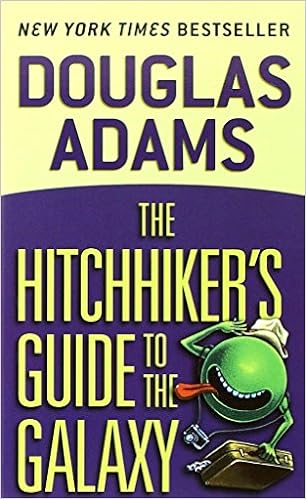
Book Review: The Hitchhiker's Guide to the Galaxy

Summary: Seconds before the Earth is demolished to make way for a galactic freeway, Arthur Dent is plucked off the planet by his friend Ford Prefect, a researcher for the revised edition of The Hitchhiker's Guide to the Galaxy who, for the last fifteen years, has been posing as an out-of-work actor.

Together this dynamic pair begin a journey through space aided by quotes from The Hitchhiker's Guide ("A towel is about the most massively useful thing an interstellar hitchhiker can have") and a galaxy-full of fellow travelers: Zaphod Beeblebrox--the two-headed, three-armed ex-hippie and totally out-to-lunch president of the galaxy; Trillian, Zaphod's girlfriend (formally Tricia McMillan), whom Arthur tried to pick up at a cocktail party once upon a time zone; Marvin, a paranoid, brilliant, and chronically depressed robot; Veet Voojagig, a former graduate student who is obsessed with the disappearance of all the ballpoint pens he bought over the years. 

Where are these pens? Why are we born? Why do we die? Why do we spend so much time between wearing digital watches? For all the answers stick your thumb to the stars. And don't forget to bring a towel!


The Hitchhiker's Guide to the Galaxy is without a doubt one of the most bizarre books I've ever read. It's almost--but not quite--seems like a parody of the space opera genre. It takes advantage of the imagination and suspension of disbelief inherent in science fiction, and runs wild with outlandish concepts and absurd plots. I sometimes think fiction could use more absurd stories, suspension of disbelief being what it is, so Hitchhiker is sort of a breath of fresh air in that respect.

One of the main themes of the books--Hitchhiker is the first book in the a series--is insignificance. It comes back to that a lot, in both explicit and implicit ways. "Everything is meaningless," it seems to say at points. "The Universe is so infinitely huge that nothing matters, because what can one insignificant being with a  lifespan of maybe ninety years do in a universe so big?" It's a solidly atheistic viewpoint--although I wouldn't say it's more atheistic than most sci-fi, like say Star Trek or Starship Troopers. It's just more honest about it.

That being said, Hitchhiker isn't a philosophical work of fiction in the same way Starship Troopers is. It's a story first and foremost, punctuated by interludes from the Hitchhiker's Guide itself. These interludes always tie into the story, and describe the larger galaxy in an oft-familiar way. Douglas Adams's galaxy is a lot like Earth in a lot of ways, albeit with much greater scale. And the titular Guide takes hardly any of it seriously--it often doesn't even take itself seriously, thanks to a collection of frustrated, underpaid, and self-serving editors. So we're left with a book--a fictional book and an actual book--that's absurd and irreverent and hilarious. It's not to everyone's taste, certainly. It's a wild ride, even when you know what's coming. But, well--it's fun. It's got elements of depth and shallowness at the same time. It's an almost dizzying spectacle, but it's fun, and since that's its primary aim, it's enjoyable. I wouldn't necessarily recommend it, because it's definitely not to everyone's taste. But if you like some of the weirder aspects of sci-fi, well, it just might be worth checking out.

Sunday, July 3, 2016

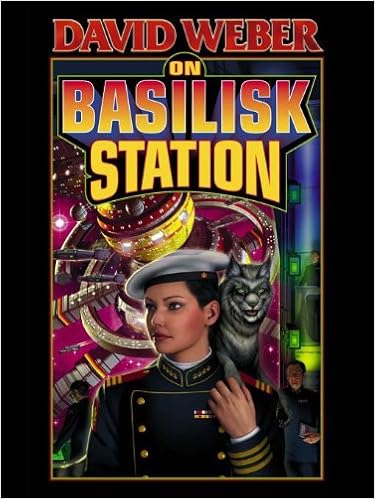
Book Review: On Basilisk Station

Summary: Having made him look a fool, she's been exiled to Basilisk Station in disgrace and set up for ruin by a superior who hates her. 

Her demoralized crew blames her for their ship's humiliating posting to an out-of-the-way picket station. 

The aborigines of the system's only habitable planet are smoking homicide-inducing hallucinogens. 

Parliament isn't sure it wants to keep the place; the major local industry is smuggling; the merchant cartels want her head; the star-conquering, so-called "Republic" of Haven is Up To Something; and Honor Harrington has a single, over-age light cruiser with an armament that doesn't work to police the entire star system. 

But the people out to get her have made one mistake. They've made her mad. 


My SF reading streak continues with On Basilisk Station, the first book in the Honor Harrington series by David Weber. This book had some similarities to the last book on my reading list (Starship: Mutiny, which I reviewed here.) It's a military SF, set in the Navy, and it starts with the protagonist with stationed on the fringes of the galaxy, in what's clearly a attempt at banishment. The difference is that Starship: Mutiny builds up the main character's disillusionment with the Navy and culminates in his desertion. On Basilisk Station builds up the main character's determination and stubbornness in the face of adversity, and culminates with her triumph and promotion. It's easy to see that these two series are heading in very different directions.

I probably enjoyed reading this book a little more than I did Starship: Mutiny. To begin with, this book's protagonist is a woman who's coded as being mixed race, and if you've spent any amount of time on my blog you know that that's my jam. And more than that, Honor Harrington is just a great main character: she's fearless, smart, ingenuitive, and stubborn. Once she realizes what needs to be done in a certain situation, she'll go to any lengths to do it, and that's both her biggest strength and weakness. She never lacks the determination to get the job done, but sometimes that determination tips over into stubbornness: she will do whatever it takes to complete her mission, no matter the cost or strain.

I mentioned in my previous review that the main character of Starship: Mutiny reminded me a little of Horatio Hornblower. I'm getting that feeling again here, the protagonists of these last two books are so similar, personality-wise. However, I think that the Honor Harrington series is more likely to follow the Hornblower series in terms of overall plot and structure. The Starship series probably isn't, since the first book ends with the main character becoming a pirate.

Overall, I really enjoyed On Basilisk Station and I would recommend it, but it had some quirks that might keep it from being unilaterally enjoyable. For one thing, there's a fair amount of politics interwoven with the plot here. I didn't mind that, because I actually love sci-fi politics. (I blame the Star Wars prequels for that.) But it could be considered distracting from the main story. There's also a few places where the author breaks off in the middle of, say, a spaceship chase scene to talk about how faster-than-light travel works in this universe. There's context for those types of tangents, and they only happen a couple of times, and only go on for a couple of pages, so I was okay with it. But it is a little jarring and, again, could very easily be considered distracting.

I also feel the need to give a couple of content warnings. There are instances of strong language throughout the story, and a few fairly detailed descriptions of battlefield gore in the last third of the book. There's also mention of and rumination upon an (unsuccessful) attempted rape in a character's backstory. (That's actually one of my only major pet peeves with this book. I wish the author had found some other way to set up conflict between a male character and a female character, because the whole "attempted rape" backstory felt kinda forced and really unnecessary.)

On the whole, though, I really enjoyed this book and look forward to reading more of the series. If you like science fiction that has action, politics, economical intrigue, and well-thought-out scientific explanations for faster-than-light travel, then this just might be the book for you.

Wednesday, June 15, 2016

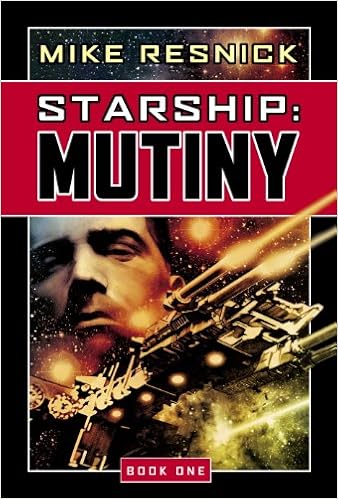
Book Review: Starship: Mutiny

Summary: The starship Theodore Roosevelt is fighting on the far outskirts of a galactic war, its crew made up of retreads and raw recruits. A new first officer reports, Wilson Cole, a man with a reputation for exceeding his orders (but getting results). He's been banished to the Teddy R. for his actions, but once there he again ignores his orders. ...

This is the first of five novels about the starship Theodore Roosevelt. The next four will be, in order, Pirate, Mercenary, Rebel, and Flagship.


So, this is the first book in a series, and as far as I can tell, it’s more of an origin story than anything else. Exterior conflict, generated by the enemy Federation, is present, but it’s minimal and not the focus of the story. Most of the book’s movement is focused on developing and showing Wilson Cole’s disillusionment with the Navy he serves.

That’s not to say it’s a boring book. There isn’t one big overarching conflict with the enemy, but there are enough battles and skirmishes to keep things interesting and advance the plot. (Come to think of it, that’s probably a more realistic structure for a novel set during a war, anyway.) There’s some good worldbuilding, though as far as I can tell it’s pretty standard for a science fiction novel. But what really drives this book are the characters.

This book tells the story of Commander Wilson Cole, and his disillusionment with, and eventual desertion of, the Republic Navy. In a similar vein to Horatio Hornblower, Cole is an extremely smart, intuitive man whose commitment to the Navy is outweighed only by his pragmatism in battle. I liked Cole well enough as a character; he’s sympathetic enough to root for and it’s fun to watch him in action. I do have a bit of a problem with how he’s written, though. Nearly all of Cole’s deductions are correct, and even when they aren’t Cole is always able to turn the situation in his favor somehow. And he doesn’t really have any personality flaws—just good traits that sometimes get him into bad situations. So I think he could have been somewhat better written.

However, on the upside, the author declined to give an in-depth description of Cole’s physical appearance, which means that I was able to imagine him as being played by Idris Elba with no authorial interference whatsoever. That was great.

The secondary characters—other crew members on Cole’s ship—were, on the whole, also enjoyable to read about. My personal favorites where Commander Podok and Christine Mboya. Christine Mboya is the best, and also wasn’t described; in the movie adaptation I’ve already constructed in my head, she would be played by Nicole Beharie. I also loved Podok’s character despite her being an antagonist; I do feel that her actions towards the end of the book were out of character and, without giving out spoilers here, let me just say that I don’t think she would have done what she did. But, well, mischaracterization happens. I’m not super bitter about it. I just think Podok was out of character and I hope she’s better written if she shows up in the sequels.

There are sequels. Four of them, to be exact. Remember how I said this is basically an origin story? Well, to be more specific, it’s a space pirate origin story. That’s my jam, and you can bet that I am going to be reading this entire series and reviewing. Whether it gets better, gets worse, or stays at the same quality level, I’m in.

As for Starship: Mutiny itself, it’s a good book. It’s not the most original thing I’ve ever read, but it’s a solid story with likable characters and a nice backdrop. There’s a solid feel to the story, and I really am looking forward to reading the sequels. I’d say that if you like old-style or classic science fiction, or the military SF sub-genre, then you’ll probably enjoy this book.

Tuesday, June 7, 2016

My Family Wouldn’t Have Existed In Any Other Century

I am biracial. I have never made any bones about this fact, because I’m proud of it. My father is a Puerto-Rican Latino and my mother is white, of Dutch and Czech descent. I’m biracial, and I’m happy about it. I wouldn’t have it any other way.

I also have an interest in history. This may be because my mother taught me to read pretty early on and homeschooled me from there. I grew up reading a lot, and a lot of the reading material provided to me was history or historical fiction. Not all of it was age-appropriate. But most of it appealed to me enough to foster an interest in stories of the historical persuasion.

I remember the first time I realized just how ahistorical my family is.

I was watching North and South with my mother and sister. For anyone who hasn’t read or seen North and South, it’s a romance set during the Industrial Revolution in England. There’s a plot point toward the middle of the story involving the main character’s brother, who fled to Spain to escape an unjust mutiny charge. The brother ends up marrying a Spanish woman.
           
So I’m watching this movie-mini-series with my mother and sister, right? And when this part comes up, my mom remarks, sort of off-handedly, “That’s the only way people from different countries really met back then. That’s how me and your dad would have met.”
           
I had never considered this before. For the first time I was confronted by the fact that in another century, my parents would likely never have met. I would not have been born to my parents in any other century, barring a few unlikely turns of events.

This was the first time I thought about this, but it would not be the last. My father has an interest in the origin of names. It turns out “Gonzalez” roughly translated means “son of a battle elf”, which is massively cool. It also turns out that it is completely legal to buy and ship an old-style forged sword. And it turns out that the family name and family legacy (and the cool sword that my family now owns) historically are passed down to the oldest son (my younger brother), not the oldest child (me).
           
It’s very cool and fun, if a tad bit frustrating, to have this family name and family sword and family legacy that gets passed down. But then again, historically, would my parents have had the opportunity to meet in Middle Ages Europe, where all this comes from? Would my siblings and I have existed in that time?
           
Fast forward. I’m out at a restaurant with my family, and we’re discussing media representation. My sister is saying that things are better than they ever were, that there are more women and people of color producing things now than there ever have been. I reply that yeah, things are better, but white people and white men especially still dominate the industry.
           
“Wow, I’m so glad you were born now and not in the 1920’s,” my mom says.
           
“Would I have been born in the 20’s? Would you guys have even met?” I gesture to my parents.
           
That’s the final word of that conversation.
           
This isn’t something that bothers me all the time. I read about history quite often and it’s fun and informative and I like doing it. I like reading about the early history of America, or the life and times of Shakespeare, or the many dynasties of ancient China. But whenever I begin to insert myself into those stories—whenever I think, Wow, what must have it been like to live then?—the knowledge is always present: I couldn’t have been there.
           
It’s fun to think about being alive during the American Revolution, but it’s not fun to know that I and my siblings would not have been safe or accepted then, assuming we were born at all. Incidentally, this has also affected my love of the time travel sub-genre. Yeah, I would love to travel back to 1885, except no I wouldn’t, because no matter how white-passing I am I know I would never feel safe. I would constantly be looking back over my shoulder because heck, do you know how long interracial marriages were illegal in the United States?

I love history. I know how important it is to study history, and more often than not I love doing it, because history contains a wealth of instructive, inspiring, hilarious, exciting and downright bizarre stories. But I don’t idealize or romanticize history. A great deal of history is sad and cruel and ugly. A lot of American history is off-putting and unwelcoming for women and people of color. I know you sometimes have to take the bad with the good, and I still see myself as an American despite all of this. But I refuse to look at history with rose-colored glasses. I don’t want to “take America back” or “make America great again” or any other variation of that sentiment, because nearly every other period of American history would have been unsafe, if not downright hostile, for my family. America has always been flawed. I want to keep moving forward, because an interracial family like mine couldn’t really have existed in any other century. I don’t want to go back to that! I want to learn as much as I can from history and, God willing, create a better world for my children and nieces and nephews.